Those particular virtues are virtues I respect, admire and value very highly. They are also virtues that can be used in ones daily life in an aspiration to become a better man. That I so highly value these virtues is probably one of the things that, in my latter days, have attracted me to collecting medals of valor and bravery. I will probably focus on medals awarded during the two greatest conflicts mankind have seen so far: WWI and WWII. This will more or less be in line with the rest of my militaria collection as well. I intend to update this thread as regularly as I can -that is: whenever I can lay my hands on a new medal.
No matter what side the recipients of these medals have thought on, they all shared one common thing: they showed grace under pressure. Grace under tremendous pressure and horror that we can hardly imagine. Some of them even sacrificed themselves so that we today can enjoy the freedom and liberty we do enjoy. My native country of Sweden have enjoyed peace for close to 200 years now. That in itself is a good -not too mention very unsual- thing. It comes at a of its own though. 200 years of peace breeds complacancy and disregards for the sacrifices that others have made. I do not share that complacancy. Nor do I disregard the sacrfices of others or take my freedom for granted. None of us should.
On a personal note though -I am not of pure Swedish decent. my dear, departed mother was of Finnish/German decent. This connects me to the sacrficies of both Finns as well as Germans. I place no political value whatsoever on these things, but judge from merit of bravery alone. Even the best sheep in the flock sometimes go astray. So as it pertains to WWII medlas, no judgement will be placed on my part on nationality or side. Allied medals as well as Axis ones will have an equal shot at gaining a place in my collection. Why? Because politics does not matter to me. It is the scourge of the common man who goes out to fight for his own, basic values and needs: Friends, family, country and homestead. All of us also know that sometimes the tide of war sweeps with it even the men who perhaps does not share their government's full values. I will not tire you all needlessly though, but to perhaps round things of a bit: When we die, we are all of the same flesh and blood. No matter how we got drawn into the conflicts we fight in.
Collecting medals is my way of remembering and paying heed to all those who despite suffering and sometimes paying very dearly, exhibited valor and bravery -for good or bad.
This first medal is a Finnish one: The Medal of Liberty 2nd Class
The medal of Liberty 2nd Class was awarded to men and NCOs who was wounded in battle. The front side of the medal feature the Finnish lion, defiantly brandishing its sword. Over the lion it features the Finnish legend "URHEUDESTA" and below it the Swedish legend "FÖR TAPPERHET". Both means "for valor". On the reverse side the legend "SUOMEN KANSALTA" -meaning "From the Finnish People"- and the date 1941. The reverse side legend signifies that this medal is a military award -as opposed to a war-time civilian award. The year signifies in what year the war started. 1941 identifies it as belonging to the Continuation War of 1941-1944.
The war was named that way on the Finnish side to signify to make clear its relationship to the Winter War where Finland lost parts of Karelia to the Soviet Union. The Continuation War began when the Soviet Union -as a reaction to Germany's Operation Barbarossa -launched bombing raids on Finland; the for the time being passive ally of Germany. Finland once again mobilized and threw themselves into battle against the Soviet Union. One of thir goals -aside of independence from the Soviet Union- was to recapture the areas they had lost in East Karelia. They fought good and they fought hard, but in the end they once again had to give up East Karelia. A truce -where Finnish demobilazation in 12 weeks were among the conditions- was signed in Moscow on September 19th, 1944. Despite all this, the Finns managed to stave of a Soviet invasion and keep their independence. 145 000 soldiers were wounded and roughly 59 000 payed for this indenpence with their lifes. The Finnish 2.45 hour-long epic "Tuntematon Sotilas" ["Unknown Soldier"] from 1955 depicts a Finnish machine gun platoon in their struggles during this particular war. There is also a remake from 1985. Both are available on DVD and are highly recommended. The original movie is based on Väinö Linna's book by the same name. Väinö Linna was a Finnish worker and frontline soldier, who in 1954 published his book. It depicts the war from the view of the common, frontline soldier and caused quite a commotion when it was first published. I am proud to say that I own a copy of the first Swedish translation, published in 1955 in Helsinki, Finland.
The medal itself is in quite excellent condition, with hardly any patination or scratches and a well preserved ribbon. According to my research a total of 239.622 of these medals were awarded between 1941 and 1945. Despite that they often shine with their absence at online auction sites.
 Attachment: 83.79 KB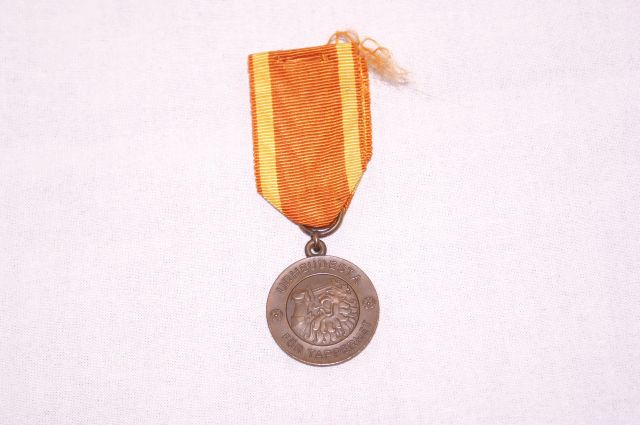
Front side of medal. Finnish legend on top and Swedish legend at the bottom.
Attachment: 80.96 KB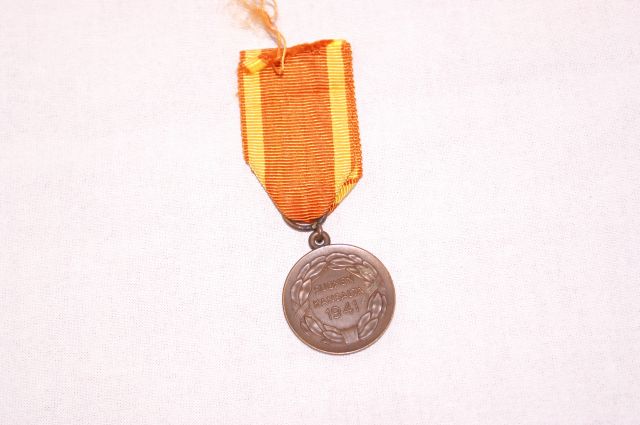
Reverse side. "SUOMEN KANSALTA 1941"