| Author |
Message |
Pedro Paulo Gaião

|
 Posted: Sat 25 Oct, 2025 8:31 am Post subject: Relating Arrow-head typology to Darts Posted: Sat 25 Oct, 2025 8:31 am Post subject: Relating Arrow-head typology to Darts |
 |
|
So, I came across a lot of stuff here and on the internet about arrow-heads typology (though I couldn't find academic sources and a more extensive typology about all the types), and I was wondering about if arrow-head typoloogy could relate to Dart-heads. That's because we do have some reproductions of darts featuring Barbed heads and there's plenty of sources talking about darts piercing through mail and coat of plates.
Ian Heath mentioned, but didn't said his sources, that Irishmen since the Middle Ages made use of darts whose heads were designed for mail-piercing. As many of you are aware, there aren't surviving dart-heads, so we can count on artistic evidence or pure speculation about the types of dart-heads it could have existed.
I was wondering if the bodkin concept was adapted for mail and "plate" piercing with darts. But, as a disclaimer, Portuguese sources that mention dart piercing through coat-of-plates occasionally mention they hit the space between "plate and plate", which I think it was a weak spot in patterns that only used central rivets.
“Burn old wood, read old books, drink old wines, have old friends.”
Alfonso X, King of Castile (1221-84)
|
|
  |
 |
Dan Howard

|
| Posted: Sat 25 Oct, 2025 2:44 pm Post subject: |
|
|
I'm convinced that the bodkin typology wasn't the armour-piercer - at least for English arrows. Consider the foillowing:
We have texts from all over the world telling us that the best arrowheads for penetrating armour need to be made of hardened steel. Modern tests seem to corroborate this.
We have other texts telling us that arrows have the best chance of penetrating armour if the arrow is a significant weight and shot at close range from a heavy bow. Modern tests seem to corroborate this.
Quite a few extant English arrowheads have now been metallurgically analysed and I can't find any studies showing a bodkin to be made of hardened steel. Only the broadheads (including the type-16 compact broadhead) are made from hardened steel.
Bodkin type arrowheads tend to outrange other arrowheads of a similar weight. Competition flight arrows used by cultures such as the Turks have heads that are bodkin-shaped. So the bodkin seems to be aerodynamically designed for improving range.
Henry Barrett wrote that English archers should carry: "a sheafe of arrows in noumber xxiv whearof I wishe viii of them more flighter than the reste to gall and annoy the enimyes farder of than the usuall custom of the sheafe arrowes, whose sharpe hallshot may not be indured."
"A sheaf of arrows, 24 in number, whereof I wish 8 of them more flightier than the rest to gall and annoy the enemies farther off than the usual custom of the sheaf of arrows, whose sharp hail-shot may not be endured." So, he is telling us that one-third of the arrows in a sheaf should be lighter arrows to harass the enemy at range.
The arrowheads on the Mary Rose did not survive but rust stains on the surface upon which they rested were analysed and it was determined that about a third of them were bodkin shaped.
So, after considering all of the above, it seems to me that the bodkin type arrowheads were intended for what the English called byker arrows - the "flighter" arrows described by Barrett used to gall the enemy at range. The compact broadhead was the amour piercer - used on heavier arrows at shorter ranges.
Author: Bronze Age Military Equipment, Pen and Sword Books
|
|
|
|
|
|
Sean Manning
|
| Posted: Sat 25 Oct, 2025 8:15 pm Post subject: |
|
|
Archaeologists have a hard time distinguishing arrowheads from javelin heads from spearheads because there are often a continuous range not three distinct clusters. So many archaeological typologies cover all three, or set an arbitrary bound between them based on overall length or socket diameter.
It seems likely that there are some dart heads from the 14th, 15th, and 16th century which have just not come to the attention of military specialists, They were popular in many parts of Europe.
weekly writing ~ material culture
|
|
|
|
|
Pedro Paulo Gaião
|
| Posted: Mon 27 Oct, 2025 3:51 am Post subject: |
|
|
| Dan Howard wrote: | Quite a few extant English arrowheads have now been metallurgically analysed and I can't find any studies showing a bodkin to be made of hardened steel. Only the broadheads (including the type-16 compact broadhead) are made from hardened steel.
[...]
Bodkin type arrowheads tend to outrange other arrowheads of a similar weight. Competition flight arrows used by cultures such as the Turks have heads that are bodkin-shaped. So the bodkin seems to be aerodynamically designed for improving range.
[...]
So, after considering all of the above, it seems to me that the bodkin type arrowheads were intended for what the English called byker arrows - the "flighter" arrows described by Barrett used to gall the enemy at range. The compact broadhead was the amour piercer - used on heavier arrows at shorter ranges. |
Very interesting point. Btw, I remember an old discussion in a post I made about the First Crusade battles and someone said the reason why the Crusader forces managed to withstand the shot of Turkish cavalry was because (I can't remember for sure now) either their bows or their arrows they were using were not fitted for penetrating mail.
----------------
Something interesting I would like to share

https://www.facebook.com/photo/?fbid=10224828388192688&set=pcb.6952152848217985
https://www.facebook.com/groups/wildeirishe/permalink/6952152848217985/
This is from a Early Modern Reenactment group called "Wilde Irish", I don't know their sources or choices for recreating the darts, but one of the does seen to fit the Mail Bodkin arrow-head.
“Burn old wood, read old books, drink old wines, have old friends.”
Alfonso X, King of Castile (1221-84)
|
|
|
|
|
Dan Howard
|
| Posted: Tue 28 Oct, 2025 3:04 pm Post subject: |
|
|
So what is the difference between a dart and a javelin? It is an arbitrary length or does a dart need to have flight feathers on the back?
Author: Bronze Age Military Equipment, Pen and Sword Books
|
|
|
|
|
Dan Howard
|
| Posted: Tue 28 Oct, 2025 3:10 pm Post subject: |
|
|
| Pedro Paulo Gaião wrote: |
This is from a Early Modern Reenactment group called "Wilde Irish", I don't know their sources or choices for recreating the darts, but one of the does seen to fit the Mail Bodkin arrow-head. |
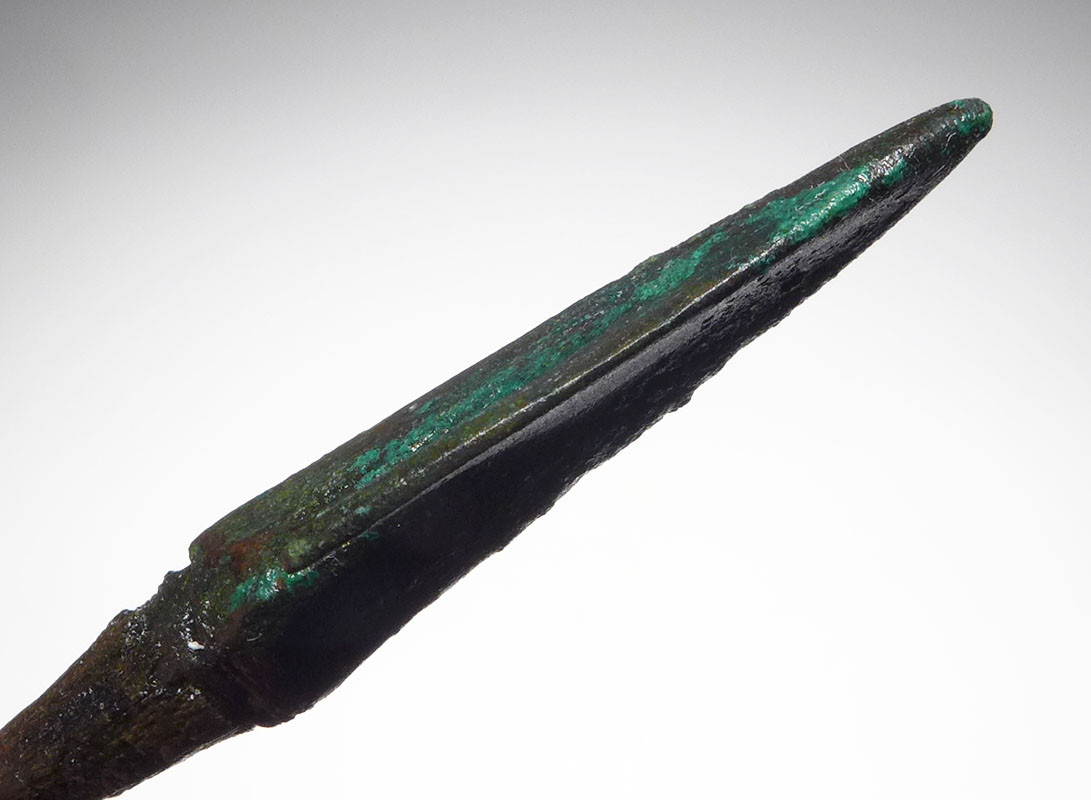
Lots of javelins and arrows had heads of this shape - including ones whose foes did not wear mail. I would suggest that the shape was simply to make it more aerodynamically stable so it can fly further.
Here is a Mycenaean bodkin dating a thousand years before mail was invented.
Author: Bronze Age Military Equipment, Pen and Sword Books
|
|
|
|
|
|
Ryan S.
|
| Posted: Wed 29 Oct, 2025 6:43 am Post subject: |
|
|
| Dan Howard wrote: | | So what is the difference between a dart and a javelin? It is an arbitrary length or does a dart need to have flight feathers on the back? |
I think they are just two different words for the same thing. If there is the idea that one has fetching and the other doesn't it might be modern, influenced by modern sports. There are a lot of words for spears and they are used interchangeably.
|
|
|
|
|
|
Anthony Clipsom
Location: YORKSHIRE, UK Joined: 27 Jul 2009
Posts: 371
|
| Posted: Thu 30 Oct, 2025 7:17 am Post subject: |
|
|
Ryan is correct. Dart was the English word used for what we call a javelin in the 16th century, a javelin then being a light cavalry spear. The Irish had several names for "darts", some of which were generic. Gae and foga usually meant the lighter dart and sleag a throwing spear according to Robert Gresh's book "Of Kerns and Gallowglasses". Gresh is a member of the Wilde Irish group.
English sources from the 16th century considered the dart ineffective against armour (we are talking plate by this stage) but very dangerous to horses. Sir Walter Raleigh lost a horse to an Irish dart in an ambush.
Anthony Clipsom
|
|
|
|
|
Pedro Paulo Gaião
|
| Posted: Fri 31 Oct, 2025 7:59 am Post subject: |
|
|
| Sean Manning wrote: | | Archaeologists have a hard time distinguishing arrowheads from javelin heads from spearheads because there are often a continuous range not three distinct clusters. So many archaeological typologies cover all three, or set an arbitrary bound between them based on overall length or socket diameter.. |
What were the boundaries they generally set? I don't read many archaeological papers about arrows/spears.
| Quote: | | It seems likely that there are some dart heads from the 14th, 15th, and 16th century which have just not come to the attention of military specialists, They were popular in many parts of Europe. |
Given by their numbers in Henry VIII's Inventories through Scotland and England, they seemed to have enjoyed a good popularity as castles' arms, and one co-worker in a journal I work showed me a number of artistic evidence of darts being used in siege contexts through Germany and elsewhere.
They were also popular in naval warfare. But for field, I think only the Spanish, Irish, Gascon, Frisian and Welsh (before assimilation somewhere in the 14th or 15th centuries) were still using them.
| Dan Howard wrote: | | So what is the difference between a dart and a javelin? It is an arbitrary length or does a dart need to have flight feathers on the back? |
In the Medieval Portuguese there isnt a distinction between a "light lance" and a "dart". The sources mainly talk about darts ("dardos") as the most popular throwing pole-pointed weapon. Spearmen (the lowest rank of Portuguese recognized military in the 14th century) and crossbowmen were required to have 2 or 3 of them, as sidearms. I think the last reference I have seen about them in pitched battles of Europe comes from the Battle of Toro in 1476, where the Castilians were employing thousands of dart-throwers against the Portuguese (which apparently were fighting against them with firearms).
Other terms were used, apparently to distinguish between different types of darts or dart-heads. Like Azcuma, which seems to be mostly for naval warfare, and Azagaia, implying a model used by Moors (perhaps feathered). Azagaia became the Assengay darts that appear in French and English textual evidence.
“Burn old wood, read old books, drink old wines, have old friends.”
Alfonso X, King of Castile (1221-84)
|
|
|
|
|
|
Will S
Location: Bournemouth, UK Joined: 25 Nov 2013
Posts: 170
|
| Posted: Sat 01 Nov, 2025 4:20 am Post subject: |
|
|
Hope folks don't mind me jumping on this - Tod sent the thread to me as we've done a huge number of films (and had uncountable conversations) on arrowheads over the years.
I'm a Master Arrowsmith with the Craft Guild of Bowyers and Fletchers and I've spent the last decade or so studying, reproducing and testing medieval arrowheads fairly obsessively!
I'd like to point out a few little things which will hopefully help -
The word "Byker" only appears once throughout history when describing arrowheads (it appears as a surname plenty more) in 1422 when describing a set of arrows held by Sir John Dynham. While many of Dynham's arrows are almost certainly military, the way the arrows fitted with Byker heads are described makes them fairly obviously civilian/non military types.
It's also worth noting that the Byker arrows are new in 1422 (while other types are described as old or feeble etc) and we know from context dated archaeological finds, contemporary artwork and Historical documents that the "bodkin" type head fell out of use in the mid 1300s, so it's unlikely that brand new arrows for a knight would be fitted in 1422 with an old, defunct head type. We know from extensive testing that bodkin shaped heads really don't work against 15thC armour, whether iron or steel - and as Dan rightly points out, evidence of case hardened or steel bodkins is virtually non existent.
"Broadheads" namely the Type 16, are usually much lighter than bodkins, but are still much more efficient. A typical small, compact, steel edged and iron socketed Type 16 will weigh between 5 and 12g, while bodkins from the final phase in their use were around 15 to 25g, and that's not counting the massive quarrels that so many people insist are arrowheads, weighing up to 40g.
Regarding the heads found on the Mary Rose, as somebody who has been working closely with the museum for years, I can confidently say that the heads on the arrows definitely weren't bodkins of any type. Public information on the actual heads is almost impossible to find, but the two extant heads recovered from the ship were barbed, as are all the heads found in sites dating to the 1530s onwards. There's even heads that were excavated from one of Henry VIII's costal castles slightly further down the coast from where the MR sank with 1535 dated barbed heads that match the two found on the ship.
Regarding darts, I've measured and weighed large barbed "hunting arrowheads" in the Royal Armouries and various private collections that are not only far too large for arrows but also too large for crossbow bolts. I assume these are dart heads, and there are LOTS of them knocking around various museums etc. One barbed head I've examined weighed 85g!
It seems to me that a new study needs to be conducted on these huge heads, as they've always been listed as arrowheads when they're clearly not.
|
|
 |
|
|
Anthony Clipsom
Location: YORKSHIRE, UK Joined: 27 Jul 2009
Posts: 371
|
| Posted: Sun 02 Nov, 2025 6:44 am Post subject: |
|
|
| Will S wrote: |
The word "Byker" only appears once throughout history when describing arrowheads (it appears as a surname plenty more) in 1422 when describing a set of arrows held by Sir John Dynham. While many of Dynham's arrows are almost certainly military, the way the arrows fitted with Byker heads are described makes them fairly obviously civilian/non military types.
|
I'm a bit wary of this conclusion Will. Byker is a variant spelling of the Middle English biker. The Middle English Compendium defines this as "A martial encounter or engagement; a skirmish, a battle; given ~, to attack; abiden ~, engage in fighting; ". To me, the obvious implication is that "byker arrow" means "battle arrow". While Ralph Moffat in his Medieval Armour Sourcebook vol 2 identifies a byker arrow as a bodkin, there doesn't seem to any reason to do so. Moffat, however, does note that "bodkin arrow" is not a medieval usage. At the time, bodkin meant a thin sharp knife or, as now, an awl.
Anthony Clipsom
|
|
|
|
|
|
Will S
Location: Bournemouth, UK Joined: 25 Nov 2013
Posts: 170
|
| Posted: Sun 02 Nov, 2025 8:34 am Post subject: |
|
|
| Anthony Clipsom wrote: | | Will S wrote: |
The word "Byker" only appears once throughout history when describing arrowheads (it appears as a surname plenty more) in 1422 when describing a set of arrows held by Sir John Dynham. While many of Dynham's arrows are almost certainly military, the way the arrows fitted with Byker heads are described makes them fairly obviously civilian/non military types.
|
I'm a bit wary of this conclusion Will. Byker is a variant spelling of the Middle English biker. The Middle English Compendium defines this as "A martial encounter or engagement; a skirmish, a battle; given ~, to attack; abiden ~, engage in fighting; ". To me, the obvious implication is that "byker arrow" means "battle arrow". While Ralph Moffat in his Medieval Armour Sourcebook vol 2 identifies a byker arrow as a bodkin, there doesn't seem to any reason to do so. Moffat, however, does note that "bodkin arrow" is not a medieval usage. At the time, bodkin meant a thin sharp knife or, as now, an awl. |
I know what you mean, and it's been a subject of debate for decades! My concern is assuming Byker comes from Biker just because it's similar. It could have come from beken, bequer etc. They all mean different things, and some mean "a pointed object", some mean beak, some mean "to peck".
There are some arrowhead types very commonly in use in the early 15thC that are for target shooting which are pointed, beak shaped heads which I believe fit the description, the archaeology, contemporary artwork and even a 15thC manuscript describing English target arrows which have "round iron heads". These could easily be described as "pecking" heads, "pointed heads" etc, because that's exactly what they look like, but they don't necessarily need to be military heads.
Ralph Moffat and I have had numerous chats over the years about the term bodkin, especially when he reached out for my thoughts on his translation of the Dynham piece for his Sourcebook, and both he and I, as well as many many historians and academics are all on the same page as you - the "bodkin" was never an arrowhead!
The main issue with the inventory that mentions Byker is that it's how Dynham's scribe is listing the heads based on appearance. They're not official terms for arrowheads at all, so we need to be very careful about using them.
|
|
|
|
|
|
Will S
Location: Bournemouth, UK Joined: 25 Nov 2013
Posts: 170
|
| Posted: Sun 02 Nov, 2025 8:54 am Post subject: |
|
|
One thing to add - everybody is very keen to take Dynhams inventory as a list of military arrows, presumably because they're more interesting and easier to visualise than target arrows.
If we dissect the info however, all of the very obviously military arrows are either fletched with peacock or grey Goose and have nocks of horn of some kind.
The byker arrows alone are fletched with white goose, and no mention is made of nocks which I take to mean they aren't given horn reinforcements. Target arrows from the 15thC are shown across multiple contemporary paintings as having the more standard swollen nocks of the 14thC. Dynham was a knight, and his arrows were extravagant, bound in gold and silk etc.
Many of his arrows would have been personal expensive target arrows and hunting arrow. The hunting arrows are described as hooked or broad hooked but we know that target heads for the 14th-17thC were usually Type 5 bullet shaped heads so it stands to reason that some of these would have been in his inventory.
We can discount the obvious war arrows with their "spearhead" and "duckbill" heads, which leaves byker heads, fitted to the only white goose fletched shafts as well as 5 small peacock ones (presumably for a younger archer) in their perfect sheaves of 24 and 48 arrows - not "old and feeble" or fletched with grey Goose feathers for heavy war arrows.
It's just my theory obviously but I think it matches the archaeology - we know what heads are in use in the 1420s and there's only about 4 types overall, and the most common found in civilian contexts are bullet shaped, round, pointy beak jobbies!
|
|
|
|
|
Pedro Paulo Gaião
|
| Posted: Sun 02 Nov, 2025 12:24 pm Post subject: |
|
|
Thanks for all your thought Will.
Just a question: what we usually consider "bodkins" (either the four-faced "plate bodkins" and the needle "mail bodkins") became out of use simply because they were inefficient?
Also, what medieval people understood as "iron" and "steel"? I find these differences in some secondary sources talking about inventories and I have no idea what they meant.
--------------------
Anyways, some price stuff I found to be usefull, from a Royal Portuguese Decree on the maximum pricing of valuables:
"The Law of Almota?aria, from 1253, gives [...] a good spear shaft was worth, at maximum, 10s - as much as an arroba of fat (a modern arroba is 15kg) -, while a good ascuma (an unknown type of dart) was at the 7s. While the irons (heads) of spears shouldn't reach prices above 4s, that means, as much as a pair of shoes made from a cow's skin. On the other side, the irons of ascumas would reach 7s, as much as an arroba of wax. More expensive were the shields and painted helmets that, still, shoudnt pass ?6, twice the price of a cubit of the best flemish scarlet (two cubits would be around a meter long). In what pertains the quivers [...] 15s.
[...]
In 1302, Louren?o Pais de Moldes, ordered that "a hauberk I own in Portalegre to be sold for ?6", while later, 1320, another hauberk was ransomed by Martim Raimundes de Portocarreira for ?10. These values, although high, doesnt reflect the original prices asked by armourers who, in their workshops, made them, which would surpass the ?23 for Jo?o Anes C?sar, in 1329, for a hauberk and a helmet who, probably, had other past owners. This was the reason why mail was often given in pledge."
Of course we should be aware that the Portuguese coinage system was very irregular and debased compared to the English Tower Pound. But it's importance, if we take things with a grain of salt, is how shafts were expensive.
“Burn old wood, read old books, drink old wines, have old friends.”
Alfonso X, King of Castile (1221-84)
|
|
|
|
|
Pedro Paulo Gaião
|
| Posted: Sun 02 Nov, 2025 12:35 pm Post subject: |
|
|
Thanks for all your thought Will.
Just a question: what we usually consider "bodkins" (either the four-faced "plate bodkins" and the needle "mail bodkins") became out of use simply because they were inefficient?
Also, what medieval people understood as "iron" and "steel"? I find these differences in some secondary sources talking about inventories and I have no idea what they meant.
--------------------
Anyways, some price stuff I found to be usefull, from a Royal Portuguese Decree on the maximum pricing of valuables:
"The Law of Almotacaria, from 1253, gives [...] a good spear shaft was worth, at maximum, 10s - as much as an arroba of fat (a modern arroba is 15kg) -, while a good ascuma (an unknown type of dart) was at the 7s. While the irons (heads) of spears shouldn't reach prices above 4s, that means, as much as a pair of shoes made from a cow's skin. On the other side, the irons of ascumas would reach 7s, as much as an arroba of wax. More expensive were the shields and painted helmets that, still, shoudnt pass 6 pounds, twice the price of a cubit of the best flemish scarlet (two cubits would be around a meter long). In what pertains the quivers [...] 15s.
[...]
In 1302, Louren?o Pais de Moldes, ordered that "a hauberk I own in Portalegre to be sold for 6 pounds", while later, 1320, another loriga was ransomed by Martim Raimundes de Portocarreira for 10 pounds. These values, although high, doesnt reflect the original prices asked by armourers who, in their workshops, made them, which would surpass the 23 pounds for Joao Anes Cesar, in 1329, for a mail shirt and a helmet who, probably, had other owners. This was the reason why mail was often given in pledge."
[...]
in 1344-1345, the selling of part of the bishop's arms had these values: 5 pounds for a pair of plate cuisses, and another 5 pounds for a pair of greaves; 3 pounds for a mail skirt; 10 pounds for a gambeson, a certainly elevated price because because the gambeson was "good and new"; 6 pounds for a barbute with mail gorjet. Some old crossbows missing parts each for 10 up to 16s, each crossbow already included a quiver and a belt.
Source: A Arte da Guerra em Portugal 1245-1367, pages 248-251.
(the book, through registers, speculates the value of a war destrier in 1300-1350 to be some 200 pounds, and rouncey to be around 20 to 30 pounds. The 1253 Law estipulates the maximum value of an un-decored horse riding gear to almost the price of an rouncey.)
Of course we should be aware that the Portuguese coinage system was very irregular and debased compared to the English Tower Pound. But it's importance, if we take things with a grain of salt, is how shafts were expensive. And the "ascuma" dart, whatever it was, had the same price (14 shillings).
“Burn old wood, read old books, drink old wines, have old friends.”
Alfonso X, King of Castile (1221-84)
|
|
|
|
|
|
Will S
Location: Bournemouth, UK Joined: 25 Nov 2013
Posts: 170
|
| Posted: Sun 02 Nov, 2025 1:07 pm Post subject: |
|
|
Yeah "bodkins" (pointy square sectioned things) are great against maille. Once you start putting plates of iron or steel over the body they become fairly useless. They had a very good understanding of steel and iron differences, and so instead of trying to make heads entirely out of expensive steel, they kept the sockets as cheap iron and forge welded steel cutting edges over them. Later in the 15thC they started to braze them as it allowed unskilled workers to produce far more arrowheads - that's why all the heads found at Towton and Tewkesbury were brazed. Cheap, quick, still going to go through maille and textile armour but it doesn't matter what you shoot at plates because you're not getting through regardless.
Don't forget that people were adding hard steel cutting edges to knives and tools all across Europe from very early on, way before the medieval period.
There are those that believe the long needle bodkins of the 13th - 14thC became heavy diamond section iron heads later on, but there's just no evidence for it. Those were for crossbows, while arrowheads were lighter, faster and edged with steel.
|
|
|
|
|
|
Sean Manning
|
| Posted: Sun 02 Nov, 2025 2:06 pm Post subject: |
|
|
The Moroccan manuscript on archery says that arrows with a four-sided section and no barbs are good for shooting at shields, coats of mail, and lamellar cuirasses. The last may be wishful thinking or meaning rawhide not iron!
The treatise does not recommend shooting at any kind of armour with broad two-barbed heads on socketed shafts like a Roman spear (Arab arrowheads usually had a tang).
| Will S wrote: | One thing to add - everybody is very keen to take Dynhams inventory as a list of military arrows, presumably because they're more interesting and easier to visualise than target arrows.
If we dissect the info however, all of the very obviously military arrows are either fletched with peacock or grey Goose and have nocks of horn of some kind.
The byker arrows alone are fletched with white goose, and no mention is made of nocks which I take to mean they aren't given horn reinforcements. Target arrows from the 15thC are shown across multiple contemporary paintings as having the more standard swollen nocks of the 14thC. Dynham was a knight, and his arrows were extravagant, bound in gold and silk etc.
Many of his arrows would have been personal expensive target arrows and hunting arrow. The hunting arrows are described as hooked or broad hooked but we know that target heads for the 14th-17thC were usually Type 5 bullet shaped heads so it stands to reason that some of these would have been in his inventory.
We can discount the obvious war arrows with their "spearhead" and "duckbill" heads, which leaves byker heads, fitted to the only white goose fletched shafts as well as 5 small peacock ones (presumably for a younger archer) in their perfect sheaves of 24 and 48 arrows - not "old and feeble" or fletched with grey Goose feathers for heavy war arrows.
It's just my theory obviously but I think it matches the archaeology - we know what heads are in use in the 1420s and there's only about 4 types overall, and the most common found in civilian contexts are bullet shaped, round, pointy beak jobbies! |
I think there are references to pile or pike arrows for shooting clouts and butts somewhere, maybe in Latin.
weekly writing ~ material culture
|
|
|
|
|
|
Sean Manning
|
| Posted: Sun 02 Nov, 2025 2:32 pm Post subject: |
|
|
| Pedro Paulo Gaião wrote: | | Also, what medieval people understood as "iron" and "steel"? I find these differences in some secondary sources talking about inventories and I have no idea what they meant. |
If you forge low-tech ferrous metals, you quickly learn that some of them are soft, malleable, and won't throw a spark (iron) and others are hard, brittle, and will throw sparks (steel). You can quench and temper some steel so it will bend and spring back, but no iron will ever do that. If you are smart you also learn that you can forge hot iron forever, but if you forge a lot of steel you will eventually damage your elbow. So it makes sense to use steel only where necessary. Experts talked about the properties of different irons or steels and what each was good for, but most people just knew the two basic categories.
weekly writing ~ material culture
|
|
|
|
|
Pedro Paulo Gaião
|
| Posted: Sun 02 Nov, 2025 4:43 pm Post subject: |
|
|
Interesting, I now realize why 14th-century Portuguese Wills, in general, often talk about "iron sabatons" and "steel gauntlets" at the same time, as if the material composition was important. Considering how hands and feet had different priorities, it makes sense using the best material to protect your hands and second-rate metal for your feet.
Froissart also has a kind of hyper-focus on Bordeaux Steel, mentioning in a number of times how English Mercenaries in Portugal and some French Mercenaries (apparently mostly were from the border regions) in Castile had spears from that region.
"Miles was created a knight by the souldich de la Traue, as being the most accomplished knight there, and the person who had been in the greatest number of brilliant actions. When the combatants were completely armed, with lances in their rests, and mounted, they spurred their horses, and, lowering their spears, met each other with such force that their lances were twice broken against their breast-plates, but no other hurt ensued. They then took their third lance, and the shock was so great that the heads of Bordeaux steel pierced their shields, and through all their other armour even to the skin, but did not wound them: the spears were shattered, and the broken pieces flew over their helmets."
https://uts.nipissingu.ca/muhlberger/froissart/roye.htm
This bear had killed four of his dogs and wounded many more, so that the others were afraid of him; upon which sir Peter drew his sword of Bordeaux steel, and advanced on the bear with great rage, on account of the loss of his dogs: he combated him a long time with much bodily danger, and with great difficulty slew him, when he returned to his castle of Languedudon, in Biscay, and had the bear carried with him.
-----
By the way, on the dart issue: I was finding strange how many bishops and nobles' inventories and rolls feature so much prominent for "azcumas" (azcona in Castilian). Its often mentioned after swords and falchions, and donated to sons of nobles as if they were made to be important.
In fact, some gifts given by King Fernando to the Emir of Granada, around mid-14th century, where these azcumas:
"el - rrei dom Fernando [ ... ] enviou estonce [ ... ] trinta azcumas todas com contos e anguados de pratas dourados , que levarom quareenta e seis marcos de prata em guarnimento ?
My attempt to translate:
"The King D. Fernando [...] thus sent [...] 30 azcumas, all decored with golden plates on their butts and blades [?], that took 46 marks of silver in decoration"
Historians have this idea that Azcuma is likely a heavier sort of dart, and it appears in a number of 15th-century sources when nobles are hunting:
"And with the pig [likely a boar or hog] leaving, the Prince, not wishing to wait, threw [his ascuma]; a most beautiful azcuma-throwing wasn't seen or heared by mountaneers, because the blades of the azcuma entered into the thighs and cut through the bones and tendons; and the blade went out with all the shaft near the butt-end of the ascuma to the other side of the beast's back"
I immediately associated that reference with barbed style heads because of the hunting association (and we know there were barbed darts). Interestingly, the few darts that show their points in the Pastrana Tapestries are actually very big feathered weapons:


Perhaps "azagaia" meant a normal type of head, but I bet that were heavy darts like this that were the ones mentioned killing knights in full armor.
“Burn old wood, read old books, drink old wines, have old friends.”
Alfonso X, King of Castile (1221-84)
|
|
|
|
|
|
Anthony Clipsom
Location: YORKSHIRE, UK Joined: 27 Jul 2009
Posts: 371
|
| Posted: Mon 03 Nov, 2025 3:23 am Post subject: |
|
|
| Quote: | | I think there are references to pile or pike arrows for shooting clouts and butts somewhere, maybe in Latin. |
Pike arrows is an interesting one. Piked basically meant pointed so you can see it being applied to certain types of bodkin arrow, but it is such a vague term I doubt you could make that connection with certainty.
Anthony Clipsom
|
|
|
|
|
|
|
You cannot post new topics in this forum
You cannot reply to topics in this forum
You cannot edit your posts in this forum
You cannot delete your posts in this forum
You cannot vote in polls in this forum
You cannot attach files in this forum
You can download files in this forum
|
All contents © Copyright 2003-2026 myArmoury.com — All rights reserved
Discussion forums powered by phpBB © The phpBB Group
Switch to the Basic Low-bandwidth Version of the forum
|





 This is a standard topic