Another thing, going a bit off-topic in my own thread ;)
While doing this literature review and wading through all the posts, I have drawn this little diagram that show how the various concepts interact with each other, and what we really measure.
This ends up looking like a bunch of noodles :D , but I still figured it could be of some help to have a more visual representation of what affects what.
The straight boxes are concepts, they are linked by arrows that shows the influence they have on other concepts. For example, Geometry affects Grip (through handle shape), Mass distribution (because it determines the volume and position of the elements), Stiffness distribution (through cross-section especially), and Cutting (edge geometry).
The curly boxes are measures, things that can be found in reviews, for example. I've put only three of these boxes: the Harmonic stats include CoP, grip node, and secondary nodes, NSHR is the metric I briefly described in the previous post, invented by Don Nelson, Dynamic stats (for lack of a better term) are what I would like to define, a set of numbers based on mass distribution (pivot points and center of gravity), hands position, tip of the sword... The blue dotted lines indicate the concept that is measured. Note that all these take the grip into account...
The last thing I've put on the diagram is perhaps the most subjective. It's all these percentages... They just reflect my opinion at the moment, I must stress that.
Around some concepts, you can see a percentage next to the arrow coming from another concept. These represent the relative influence on the central concept. For example, I consider that the Cutting behaviour is affected 40% by the target behaviour, 30% by the sword dynamic model (that includes user actions), 20% by geometry (without cutting edge, no cut), and only 10% by harmonics.
And next to the blue links, there are percentages that represent what fraction of the concept is actually measured. For example we rarely measure the grip fully (at best beginning/end). I've only attributed 50% of the harmonic model to the harmonic stats because really, we only capture part of the vibrating behaviour of a sword (proof is, a sword struck at the CoP also vibrates, just differently). In fact we see at best two harmonics, and without even the waveform.
As I said this last part is largely subjective, and open to debate. I felt it was necessary to include this, in order to keep a perspective on what has the strongest influence.
I'm sure this representation is lacking many things. Feel free to post any suggestion or criticism. I'm wishing to improve that...
Best,
 Attachment: 29.91 KB
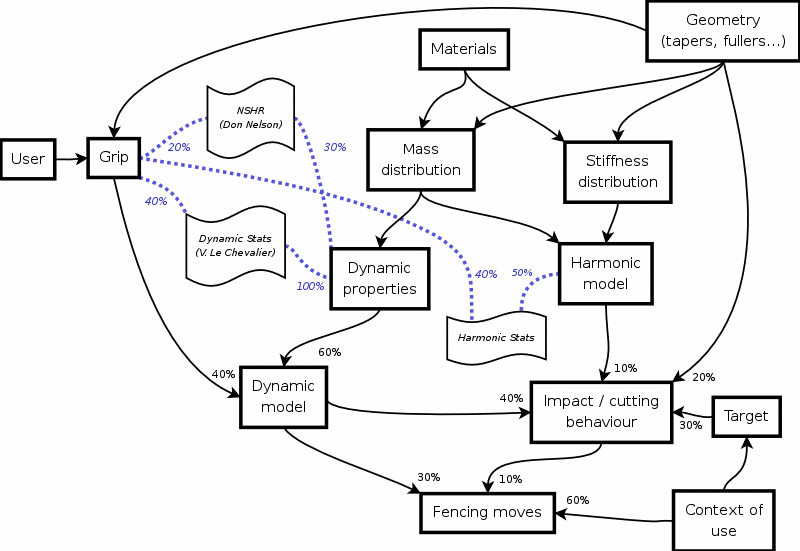
Diagram of how the various balance concept interplay, down to fencing...
While doing this literature review and wading through all the posts, I have drawn this little diagram that show how the various concepts interact with each other, and what we really measure.
This ends up looking like a bunch of noodles :D , but I still figured it could be of some help to have a more visual representation of what affects what.
The straight boxes are concepts, they are linked by arrows that shows the influence they have on other concepts. For example, Geometry affects Grip (through handle shape), Mass distribution (because it determines the volume and position of the elements), Stiffness distribution (through cross-section especially), and Cutting (edge geometry).
The curly boxes are measures, things that can be found in reviews, for example. I've put only three of these boxes: the Harmonic stats include CoP, grip node, and secondary nodes, NSHR is the metric I briefly described in the previous post, invented by Don Nelson, Dynamic stats (for lack of a better term) are what I would like to define, a set of numbers based on mass distribution (pivot points and center of gravity), hands position, tip of the sword... The blue dotted lines indicate the concept that is measured. Note that all these take the grip into account...
The last thing I've put on the diagram is perhaps the most subjective. It's all these percentages... They just reflect my opinion at the moment, I must stress that.
Around some concepts, you can see a percentage next to the arrow coming from another concept. These represent the relative influence on the central concept. For example, I consider that the Cutting behaviour is affected 40% by the target behaviour, 30% by the sword dynamic model (that includes user actions), 20% by geometry (without cutting edge, no cut), and only 10% by harmonics.
And next to the blue links, there are percentages that represent what fraction of the concept is actually measured. For example we rarely measure the grip fully (at best beginning/end). I've only attributed 50% of the harmonic model to the harmonic stats because really, we only capture part of the vibrating behaviour of a sword (proof is, a sword struck at the CoP also vibrates, just differently). In fact we see at best two harmonics, and without even the waveform.
As I said this last part is largely subjective, and open to debate. I felt it was necessary to include this, in order to keep a perspective on what has the strongest influence.
I'm sure this representation is lacking many things. Feel free to post any suggestion or criticism. I'm wishing to improve that...
Best,
Attachment: 29.91 KBDiagram of how the various balance concept interplay, down to fencing...
| Vincent Le Chevalier wrote: |
|
As far as I know, the first published work involving inertia and pivot points (fundamental for a study of dynamic balance) is the article by George Turner, from the ARMA: http://www.thearma.org/spotlight/GTA/motions_and_impacts.htm There is a more complete (and mathematically heavy) version of this article here: http://armor.typepad.com/bastardsword/sword_dynamics.pdf The first part is pretty much a must-read for mass distribution and pivot points. Even though I do not necessarily agree with the way the physics are presented, the author does a very good job explaining with as few equations as possible. The rest of the article I find less convincing, because it tends to simplify the situation too much. The author tends to focus on proving how the forward pivot point should be at the tip, which is not true in my opinion. Sadly, this article suffered from some political orientation and use, and perhaps because of that was not debated and expanded as it should have been. It has also caused some kind of silence afterwards, as the simple fact of bringing up balance problems in a discussion tended to degenerate. The only academic, scientific paper on sword balance that I'm aware of is the following publication: Swordplay: an exercise in rotational dynamics, Mark Denny, 2006, Eur. J. Phys. 27, 943-950 (sadly, not freely available as far as I could find). Interesting from the physics point of view, but it seems the author is not so much knowledgeable of swords and their uses. Thus, he misses several possible applications of his physics... It is a bit similar in the end results to Turner's article. Some of the assumption about mass distribution are too rough to be really useful for an analysis of real swords in my opinion. |
Firstly: It would be more accurate to state that either of George Turner's papers suffer only from a lack of mathematical and scientific knowledge of even basic physics by most readers, including but not limited to many modern sword-fabricators & vendors. There is nothing inherently "political" about either of GT's papers. If a reader cannot understand those, then it is his fault and not that of GT. Indeed, GT goes to great pains in each paper, including the full version PDF, to make things clear for those who may not be as talented as GT at math & science.
Secondly: Both of GT's articles, whether the condensed version at ARMA or the full 152 page PDF, are each a "scientific paper", hence Denny's could hardly be called the "only" such paper.
Thirdly: If somebody wants to understand those papers, he ought to read them for himself, instead of relying upon manifold opinions (many of which are mercantile-laden) at various online forums.
Good post Vincent. I suspect that what you have posted could become a very good resource........
Jeffrey,
The very fact that George Turner took those great pains shows that he was well aware of the situation, and that he was expecting to actually explain things to people instead of just shouting them down because they were not good at math. What I observed is that many readers, after thinking about it, and doing the math, were not convinced by the conclusions of George Turner (and that includes myself). It's not a question of math, but of how he models the sword to apply the math, and what he is looking for with his model.
It is the only such paper (I said academic, perhaps the term is badly chosen, English is not my first language), in the sense that it was published in a scientific journal, with a process of official peer-review. Neither of George Turner's articles, as far as I know, were in this case.
Putting a PDF with equations out on the web, however well researched and truthful it is, does not count as a scientific publication. I'm currently going through the trouble of having my paper reviewed in the course of my PhD, and I can attest that it is vastly more demanding than publishing on a web site. However, I consider that for swords, it is not a problem: no paper on sword balance will contain breakthrough in physics; it is a matter of explaining the physics, supporting one's theory with evidence, and convincing people of the value of the theories. For the record I consider that Mr Turner's articles were more valuable than that of Mr Denny, so it's not an appreciation of quality or usefulness when I say academic.
Well that was kind of my point when composing the original post, I expect interested people would actually click on the links and read for themselves :D
You will note that I did not include any of the subsequent "discussions" that happened about these papers because the signal to noise ratio was somewhat low. However the opinions of others are important as well, if only to understand what they explain, how they are wrong maybe, or what evidence they provide that is not covered by other's theories.
I'll say a final word about politics (and hopefully we will leave it at that). The article by George Turner, the one hosted by Arma, was indeed voluntarily controversial about some points, and that was readily perceptible by anyone familiar with the community (that did not really include me at the time). The way it disparages harmonic balance was unnecessary, because finding a link between both approaches is easy, as I've shown in one of my previous posts (and confirmed recently through simulation).And it looks like it was added as a last twist to the article. Worse, the article was used politically (and there is not one side to blame particularly for that, it just happened), to discuss matters that have little to do with science or sword study. That did great disservice to George Turner's article and the concepts he describes (because as your post shows, simply mentioning it tends to stir the pot), and I would be grateful if these kind of "debates" could stay away from here...
Regards,
| Jeffrey Hull wrote: |
| There is nothing inherently "political" about either of GT's papers. If a reader cannot understand those, then it is his fault and not that of GT. Indeed, GT goes to great pains in each paper, including the full version PDF, to make things clear for those who may not be as talented as GT at math & science. |
The very fact that George Turner took those great pains shows that he was well aware of the situation, and that he was expecting to actually explain things to people instead of just shouting them down because they were not good at math. What I observed is that many readers, after thinking about it, and doing the math, were not convinced by the conclusions of George Turner (and that includes myself). It's not a question of math, but of how he models the sword to apply the math, and what he is looking for with his model.
| Quote: |
| Secondly: Both of GT's articles, whether the condensed version at ARMA or the full 152 page PDF, are each a "scientific paper", hence Denny's could hardly be called the "only" such paper. |
It is the only such paper (I said academic, perhaps the term is badly chosen, English is not my first language), in the sense that it was published in a scientific journal, with a process of official peer-review. Neither of George Turner's articles, as far as I know, were in this case.
Putting a PDF with equations out on the web, however well researched and truthful it is, does not count as a scientific publication. I'm currently going through the trouble of having my paper reviewed in the course of my PhD, and I can attest that it is vastly more demanding than publishing on a web site. However, I consider that for swords, it is not a problem: no paper on sword balance will contain breakthrough in physics; it is a matter of explaining the physics, supporting one's theory with evidence, and convincing people of the value of the theories. For the record I consider that Mr Turner's articles were more valuable than that of Mr Denny, so it's not an appreciation of quality or usefulness when I say academic.
| Quote: |
| Thirdly: If somebody wants to understand those papers, he ought to read them for himself, instead of relying upon manifold opinions (many of which are mercantile-laden) at various online forums. |
Well that was kind of my point when composing the original post, I expect interested people would actually click on the links and read for themselves :D
You will note that I did not include any of the subsequent "discussions" that happened about these papers because the signal to noise ratio was somewhat low. However the opinions of others are important as well, if only to understand what they explain, how they are wrong maybe, or what evidence they provide that is not covered by other's theories.
I'll say a final word about politics (and hopefully we will leave it at that). The article by George Turner, the one hosted by Arma, was indeed voluntarily controversial about some points, and that was readily perceptible by anyone familiar with the community (that did not really include me at the time). The way it disparages harmonic balance was unnecessary, because finding a link between both approaches is easy, as I've shown in one of my previous posts (and confirmed recently through simulation).And it looks like it was added as a last twist to the article. Worse, the article was used politically (and there is not one side to blame particularly for that, it just happened), to discuss matters that have little to do with science or sword study. That did great disservice to George Turner's article and the concepts he describes (because as your post shows, simply mentioning it tends to stir the pot), and I would be grateful if these kind of "debates" could stay away from here...
Regards,
I am curious (not really arguing, had just not evaluated it before) about your comment about disagreeing with GT's claim that pivot points near the tip of the sword were a primary historical objective of large pommels.
A section of his article that might be what your are referring to reads; "If the desired pivot point was anywhere near one third back from the tip, why use a pommel at all? Just leave it off and have the sword pivot around a point about a third back from the tip, just like a saber. So I would say that if a sword has a real pommel, it would only logically be used to create a pivot point very near the tip."
I can see two sides of the argument; Wanting to make damage significant at maximum reach. Wanting to dampen hand shock from natural harmonics when striking at the CoP. Is it possible that historically accurate (heavy) pommels do a good job of achieving both?
A section of his article that might be what your are referring to reads; "If the desired pivot point was anywhere near one third back from the tip, why use a pommel at all? Just leave it off and have the sword pivot around a point about a third back from the tip, just like a saber. So I would say that if a sword has a real pommel, it would only logically be used to create a pivot point very near the tip."
I can see two sides of the argument; Wanting to make damage significant at maximum reach. Wanting to dampen hand shock from natural harmonics when striking at the CoP. Is it possible that historically accurate (heavy) pommels do a good job of achieving both?
Hi Jared,
As far as I'm aware, the fact that original swords would all have the pivot point of their cross located at the tip is unsupported... Which means that any explanation as to why this would be optimal must be missing part of the picture. For this I rely mainly on observations Peter Jonhsson made, because he has been documenting a good number of originals with respect to pivot points. A rough summary of the conclusions can be found on Albion's site (http://www.albion-swords.com/swords/sword-terms.htm):
It is possible that the sample of antique swords that George Turner says he has studied, being all from the XVIth century, were in fact aiming for thrusting capability, and so were indeed all with a forward pivot near the tip. Extending this observation to all swords is apparently factually wrong.
I think that the error is to focus too much on impacts, and on very slight variations of the energy they can use. My belief is that the placement of pivot points have a far greater incidence on the feel of the sword, and its ease of use, than they have on impact energy. This is readily apparent on one of Mr Turner's own graph (http://www.thearma.org/spotlight/GTA/motions_...age019.gif). See how an enormous variation of pommel mass only has a slight impact on dissipated energy at the tip, making it go only from 60 to 70 J... Perhaps you'd just need only 40J to make a kill anyway. Note also that the pommel mass ranges here from 0 to 800g. I think anyone can imagine the wide difference in handling between a weapon where the pommel is absent and one where the pommel weighs about as much as the blade.
My own take on the subject is that the pommel is there to fine-tune the feel of the blade. Adding the pommel, you diminish blade presence, and bring the forward pivot closer to the tip, which increases tip control and feel, i.e. you know, without having to look, exactly where the tip is, and it does not under- or over-thrust. But you also make the sword heavier, and you bring the aft pivot forward a bit as well, wich slightly modifies tracking in cuts. So there is a compromise to make.
When aiming for a thrusting sword, you will sacrifice blade presence and bring the forward pivot near the tip. This will not be done only with the pommel, the blade itself is designed with this goal in mind, and the pommel allows you to reach it without adding too much mass. When doing a cutting sword, you need to keep blade presence, because it gives authority in the cut (your blade will not be easy to set aside) but you don't care as much for tip control. So you let the forward pivot sink back towards CoP.
The reason the CoP (which is indeed always about a third back from the tip) stays generally between the aft and forward pivot point, is that hard impact against heavy targets tend to be made with the CoP (assuming this is tactically possible), because it increases the "bite" of the sword, negating the possiblity of exciting high-amplitude flat-to-flat vibrations. But you don't want to feel such hard impacts too much in your hand, so the pivot point of the CoP should be somewhere on the handle. Which, translating this fact into pivot points, means that the CoP is between the aft and forward pivot point.
And since the handle node is very close to the CoP's pivot point, which is somewhere on the handle (generally closer to the cross on one-handed swords), it means that the handle node is indeed somewhere in the grip, or very close. Which is one of the basis that makes people say that a sword is harmonically balanced.
I'm not saying this tells the whole story, but I find it more satisfying than analyzing everything with impacts, making wildly unverifiable assumptions about the target and the motion of the sword (which in part is conditioned by the handling properties as well), as well as efficiency of the cuts.
I hope this clarifies my position,
As far as I'm aware, the fact that original swords would all have the pivot point of their cross located at the tip is unsupported... Which means that any explanation as to why this would be optimal must be missing part of the picture. For this I rely mainly on observations Peter Jonhsson made, because he has been documenting a good number of originals with respect to pivot points. A rough summary of the conclusions can be found on Albion's site (http://www.albion-swords.com/swords/sword-terms.htm):
| Quote: |
| the proper location of the pivot point will vary depending on the purpose of the sword -- a thrusting sword should have a pivot point located at the very tip of the blade point, a cutting sword may have a pivot point close to or corresponding to the CoP. |
It is possible that the sample of antique swords that George Turner says he has studied, being all from the XVIth century, were in fact aiming for thrusting capability, and so were indeed all with a forward pivot near the tip. Extending this observation to all swords is apparently factually wrong.
I think that the error is to focus too much on impacts, and on very slight variations of the energy they can use. My belief is that the placement of pivot points have a far greater incidence on the feel of the sword, and its ease of use, than they have on impact energy. This is readily apparent on one of Mr Turner's own graph (http://www.thearma.org/spotlight/GTA/motions_...age019.gif). See how an enormous variation of pommel mass only has a slight impact on dissipated energy at the tip, making it go only from 60 to 70 J... Perhaps you'd just need only 40J to make a kill anyway. Note also that the pommel mass ranges here from 0 to 800g. I think anyone can imagine the wide difference in handling between a weapon where the pommel is absent and one where the pommel weighs about as much as the blade.
My own take on the subject is that the pommel is there to fine-tune the feel of the blade. Adding the pommel, you diminish blade presence, and bring the forward pivot closer to the tip, which increases tip control and feel, i.e. you know, without having to look, exactly where the tip is, and it does not under- or over-thrust. But you also make the sword heavier, and you bring the aft pivot forward a bit as well, wich slightly modifies tracking in cuts. So there is a compromise to make.
When aiming for a thrusting sword, you will sacrifice blade presence and bring the forward pivot near the tip. This will not be done only with the pommel, the blade itself is designed with this goal in mind, and the pommel allows you to reach it without adding too much mass. When doing a cutting sword, you need to keep blade presence, because it gives authority in the cut (your blade will not be easy to set aside) but you don't care as much for tip control. So you let the forward pivot sink back towards CoP.
The reason the CoP (which is indeed always about a third back from the tip) stays generally between the aft and forward pivot point, is that hard impact against heavy targets tend to be made with the CoP (assuming this is tactically possible), because it increases the "bite" of the sword, negating the possiblity of exciting high-amplitude flat-to-flat vibrations. But you don't want to feel such hard impacts too much in your hand, so the pivot point of the CoP should be somewhere on the handle. Which, translating this fact into pivot points, means that the CoP is between the aft and forward pivot point.
And since the handle node is very close to the CoP's pivot point, which is somewhere on the handle (generally closer to the cross on one-handed swords), it means that the handle node is indeed somewhere in the grip, or very close. Which is one of the basis that makes people say that a sword is harmonically balanced.
I'm not saying this tells the whole story, but I find it more satisfying than analyzing everything with impacts, making wildly unverifiable assumptions about the target and the motion of the sword (which in part is conditioned by the handling properties as well), as well as efficiency of the cuts.
I hope this clarifies my position,
| Jared Smith wrote: |
| I am curious (not really arguing, had just not evaluated it before) about your comment about disagreeing with GT's claim that pivot points near the tip of the sword were a primary historical objective of large pommels.
|
after i read GT's paper I CAD modeled some swords to checked GT's numbers, I did not have any historic data to model actual swords, i was just checking the numbers, and as far I got he was close enough ( or I was).
however as Vincent quoted from someone the COP should be related to the use of the sword, i think GT was modeling and investigated a particular style/use sword.
as for handling, the COP is related to the Center of Oscillation, (this is why GT pendulum test works) and that effects the swords handling. the smiths of old in improving their product ,and thereby business and revenue, made the best TOOL for there clients that they could. you can analyze primary, secondary and tertiary harmonic nodes for as long as you like and add complexity to the model, but the end result must be a quality SWORD not a tuning fork. ;)
don't take that the wrong way, the modeling and research is great as long as a tangible result is achieved, (i.e. a mathematical model a modern smiths can use in designing a new sword that will handle like a historic one)
I, myself will be very interested to see that information published.
keep crunching those numbers
Joe
Vadim
spot on!
i'll have to look at that formula you posted and compare it to what my 3d cad model tells me for a moment of inertia. where did you base the axises for I at the guard?
i completely agree with you post on http://www.thearma.org/forum/viewtopic.php?t=23300.
and yes of course to close the loop the big need is to find what the dimensions and weights are of swords (by type) that handle and cut very well and see what moments of inertia ( and radii of gyration , etc) are.
i might even turn out to be as simple as GT's paper said about most historic swords having a center of oscillation or percussion at the tip with reference to the base of the blade at the guard, then the pendulum test would be all you need.
so where are those volunteers with the spare time.
Joe
spot on!
i'll have to look at that formula you posted and compare it to what my 3d cad model tells me for a moment of inertia. where did you base the axises for I at the guard?
i completely agree with you post on http://www.thearma.org/forum/viewtopic.php?t=23300.
and yes of course to close the loop the big need is to find what the dimensions and weights are of swords (by type) that handle and cut very well and see what moments of inertia ( and radii of gyration , etc) are.
i might even turn out to be as simple as GT's paper said about most historic swords having a center of oscillation or percussion at the tip with reference to the base of the blade at the guard, then the pendulum test would be all you need.
so where are those volunteers with the spare time.
Joe
Hurrah! Finally, I have found some sword enthusiasts who believe in physics. Thank you, gentlemen! We could give this a try, slowly building up a database of measured and calculated swords. If enough people contribute we could reach some critical mass where this project would actually become useful.
Josef - yes, it will work best relative to guard due to some assumptions I made to simplify the math. But it's not a bad thing - it could be used as a yardstick to compare different swords, and then one could use it to do more accurate calculations for any pivot point.
Vincent - I missed your recent thread; lately I have only checked the historical arms forum, and probably missed a lot of good stuff on the off-topic one. I must say that I like your approach better. A numeric solution should be more accurate than an analytical one. It's more universal and does not make as many assumptions. For example, the weakest part of my model is the assumption that the cross-sectional area changes linearly along the sword's length. It will work fine as an estimate, but you'd almost have to construct a new model for each sword shape to get any real accuracy. Yes, I'd like to see your type XI measurements - could you PM them to me? - and then we could compare the results.
Vadim.
Josef - yes, it will work best relative to guard due to some assumptions I made to simplify the math. But it's not a bad thing - it could be used as a yardstick to compare different swords, and then one could use it to do more accurate calculations for any pivot point.
Vincent - I missed your recent thread; lately I have only checked the historical arms forum, and probably missed a lot of good stuff on the off-topic one. I must say that I like your approach better. A numeric solution should be more accurate than an analytical one. It's more universal and does not make as many assumptions. For example, the weakest part of my model is the assumption that the cross-sectional area changes linearly along the sword's length. It will work fine as an estimate, but you'd almost have to construct a new model for each sword shape to get any real accuracy. Yes, I'd like to see your type XI measurements - could you PM them to me? - and then we could compare the results.
Vadim.
Page 1 of 1
You cannot post new topics in this forumYou cannot reply to topics in this forum
You cannot edit your posts in this forum
You cannot delete your posts in this forum
You cannot vote in polls in this forum
You cannot attach files in this forum
You can download files in this forum
All contents © Copyright 2003-2006 myArmoury.com — All rights reserved
Discussion forums powered by phpBB © The phpBB Group
Switch to the Full-featured Version of the forum
Discussion forums powered by phpBB © The phpBB Group
Switch to the Full-featured Version of the forum