| Author |
Message |
Rodolfo Martínez

|
 Posted: Sun 13 May, 2007 10:33 am Post subject: Length of cavalry swords. Posted: Sun 13 May, 2007 10:33 am Post subject: Length of cavalry swords. |
 |
|
Hello people.
What size do you think a single-handed arming sword or a hand-and-a-half sword ( Dating around 1450-1550) should have to be efficient for horseback use by heavy/light cavalry?
What do you think about curved swords of the period like Cimitars?
Thanks.
¨Sólo me desenvainarás por honor y nunca me envainarás sin gloria¨
|
|
  |
 |
|
Peter Bosman
|
| Posted: Sun 13 May, 2007 12:30 pm Post subject: Re: Lenght of cavalry swords. |
|
|
| Rodolfo Martínez wrote: | Hello people.
What size do you think a single-handed arming sword or a hand-and-a-half sword ( Dating around 1450-1550) should have to be efficient for horseback use by heavy/light cavalry?
What do you think about curved swords of the period like Cimitars?
Thanks. |
The period you mention sees the reiterschwert or backsword as a typical sword for úse by the mounted men in the west. I put the stress on use as they would also use a mace or the like for primary use and carry a shorter sword as backup.
The eastern counterparts used both straight double edged sword and lightly curved sabres.
Bear in mind that the principal use of the sword was cutting against unmounted adversaries and thus would be relatively long, longer than an infantry sword.
I am doing a lot of mounted experimenting and am not at all enthousiastic about the sword for this at all, possibly with the exception of running down fleeing infantry with a sabre which I have not tried 
As it is I do not quite understand the reiterschwert unless it was primairily a weapon for mounted guards against unarmed or simply armed footmen from the third class. The equivalent of a riot-gun.
Peter
|
|
|
|
|
Gordon Frye

|
| Posted: Sun 13 May, 2007 9:04 pm Post subject: |
|
|
Rodolfo;
I would imagine that somewhere in the neighborhood of 35-40 inches (89-101 cm) in blade length would be about the best. I've found that the several Renaissance-style swords which I own that are approximately 37-38 inches (94-97cm) in blade length are just about perfect, though. And it turns out that such a length for horseman's swords are fairly common.
It has to be long enough that you can touch the ground with the tip while you're in the saddle, but still short enough for you to draw effectively from the scabbard when mounted, so it can also depend upon the height of the man, the horse, etc. These rather conflicting demands tend to dictate the optimum length. I'm tall, but I ride a tall horse, so that length is just right for me.
As per simitars/sabres, not many folks in Western Europe were playing with them at the time, so I couldn't say much about their use.
Cheers,
Gordon
"After God, we owe our victory to our Horses"
Gonsalo Jimenez de Quesada
http://www.renaissancesoldier.com/
http://historypundit.blogspot.com/
|
|
  |
|
|
Lafayette C Curtis
|
| Posted: Mon 14 May, 2007 3:28 am Post subject: |
|
|
Well, just to add my two cents, on horseback I tend to be most comfortable with swords ranging between 32 and 36 inches in length, while on foot I'd willingly take blades all the way from twenty to forty inches. So the demands of mounted combat (whether against foot or mounted opponents) places a greater restriction on the practical length of swords than those of foot combat.
As far as I can tell, the same range of length applies roughly to both straight and curved swords because even with curved swords you'd still want something that has enough reach in both the cut and the thrust.
|
|
|
|
|
Rodolfo Martínez
|
| Posted: Mon 14 May, 2007 9:27 am Post subject: |
|
|
When you say, for example 35 inches sword, are you refering to it´s blade or to the overall lenght including the grip and pommel?
¨Sólo me desenvainarás por honor y nunca me envainarás sin gloria¨
|
|
|
|
|
|
Peter Bosman
|
| Posted: Mon 14 May, 2007 10:13 am Post subject: |
|
|
| Rodolfo Martínez wrote: | | When you say, for example 35 inches sword, are you refering to it´s blade or to the overall lenght including the grip and pommel? |
The blade.
I have selected some examples from the same source so you get a better comparison.
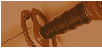
The 'German backsword' by MRS is a nice example of an effective rider's sword.
[ Linked Image ]
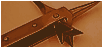
From the same source also comes a non-cavalry instrument labeled 'German huntingsword' which Í would choose as a civilian and would be even nicer with a false edge.
[ Linked Image ]
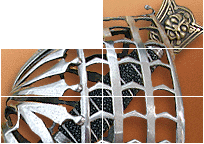
If unrestricted by western vs. eastern the scimitar would be a nice option. It may seem a bit short but then muslim cavalry was primarily intended to harass infantry and fíght other cavalrymen, not contact infantry.
[ Linked Image ]
I guess it depends on whó you want to 'be' in your time-frame....
Peter
|
|
|
|
|
Rodolfo Martínez
|
| Posted: Mon 14 May, 2007 1:13 pm Post subject: |
|
|
| Quote: | | I would imagine that somewhere in the neighborhood of 35-40 inches (89-101 cm) in blade length would be about the best. I've found that the several Renaissance-style swords which I own that are approximately 37-38 inches (94-97cm) in blade length are just about perfect, though. And it turns out that such a length for horseman's swords are fairly common. |
Almost a hand-and-a-half sword blade size?
Are arming swords intended for buckler combat shorter than cavalry ones?
¨Sólo me desenvainarás por honor y nunca me envainarás sin gloria¨
|
|
|
|
|
|
George Hill
Location: Atlanta Ga Joined: 16 May 2005
Posts: 616
|
| Posted: Mon 14 May, 2007 6:51 pm Post subject: |
|
|
Take this with a grqain of salt, as I don't remember where I heard it....
But I read somewhere, (this was before I knew as much as I do now.) that a Knight would carry two swords, one shorter, one longer, (Which I now know to be the longsword and the arming sword.) and on horseback, the longsword (used one handed,) was prefered against infantry, and the shorter against other mounted enemies.
However, as I do not remember the origin of the above, I again point out that it should not be taken to heart unless someone else has more. I would very much like to know if anyone has a historical basis for the above.
To abandon your shield is the basest of crimes. - --Tacitus on Germania
|
|
 |
|
|
Lafayette C Curtis
|
| Posted: Mon 14 May, 2007 11:33 pm Post subject: |
|
|
| George Hill wrote: | Take this with a grqain of salt, as I don't remember where I heard it....
But I read somewhere, (this was before I knew as much as I do now.) that a Knight would carry two swords, one shorter, one longer, (Which I now know to be the longsword and the arming sword.) and on horseback, the longsword (used one handed,) was prefered against infantry, and the shorter against other mounted enemies.
However, as I do not remember the origin of the above, I again point out that it should not be taken to heart unless someone else has more. I would very much like to know if anyone has a historical basis for the above. |
No, it's perfectly correct. At least it was the comon practice in the late 15th century and the early 16th, though I believe it began a bit earlier.
And the one-handed sword was used on horseback, not against mounted opponents. It was meant to be usable against both kinds of opponents--foot and mounted--especially in the pursuit, when they have been successfully routed.
| Rodolfo Martínez wrote: | Almost a hand-and-a-half sword blade size?
Are arming swords intended for buckler combat shorter than cavalry ones? |
It depends on what you mean by a "hand-and-a-half sword blade size." If it means the blade size of "hand-and-a-half swords" as a distinct class of swords, then I'd say there's simply no such thing. The blades of hand-and-a-half swords could vary all the way from 28 to 40 inches depending on the wielder's stature and preferred fighting style, so if anything it's an even less restrictive category than the practical length of blades for horseback use. Moreover, if you look at some of the earlier sword types like Types X, XI, XII, and XIII, you'll see that many of them had very long blades but strictly one-handed grips.
If you mean that the blades are long enough to be effectively used two-handed, then the answer is yes. Some of them were in fact hand-and-a-half swords--like the espee a deux mains prescribed for the mounted archers of the Ordinance. And many of the ordinarily single-handed swords would have performed reasonably well when wielded in two hands.
The problem here is that when you're asking about late-medieval and early Renaissance sword types for mounted use, you definitely would get a wide variety since the question, by definition, encompasses a fairly broad range of sword types. You'd find anything from Type XV to Type XIX--not to mention old heirloom swords that might have survived the passage of time!
|
|
|
|
|
Rodolfo Martínez
|
| Posted: Tue 15 May, 2007 5:48 am Post subject: |
|
|
| Quote: | | Quote: | George Hill wrote:
Take this with a grqain of salt, as I don't remember where I heard it....
But I read somewhere, (this was before I knew as much as I do now.) that a Knight would carry two swords, one shorter, one longer, (Which I now know to be the longsword and the arming sword.) and on horseback, the longsword (used one handed,) was prefered against infantry, and the shorter against other mounted enemies. |
However, as I do not remember the origin of the above, I again point out that it should not be taken to heart unless someone else has more. I would very much like to know if anyone has a historical basis for the above.
No, it's perfectly correct. At least it was the comon practice in the late 15th century and the early 16th, though I believe it began a bit earlier.
And the one-handed sword was used on horseback, not against mounted opponents. It was meant to be usable against both kinds of opponents--foot and mounted--especially in the pursuit, when they have been successfully routed |
I see a more versatile weapon in the longsword because, if unhorsed, i have that sword near me (In my hand or sccabard) wich is a perfect sword for foot combat. But i´m not sure what about chaotic mounted melees, maybe the shorter one would be better. I guess it would be a personal preference of the owner but since i have little proof of that Why would a XVI century knight (I guess 1500-1550) carry a longsword too if it is suposed that they never used to dismount during a battle and a single handed sword could make a great job if unhorsed even if that longsword is perfectly fit for horsed combat? (That´s why i have so many doubts about Gendarmes use of the Longsword and i´m bothering around so much)
When i refer to to hand-and-a-half swords i refer to later (XV and XVI century) types of longswords, such as Type XX, or Type XVIIIe because i have some terminology problems so, i try to use the ¨generic¨ name. Next time i´ll try to be more specific.
Do you know how longswords were called in that time?
¨Sólo me desenvainarás por honor y nunca me envainarás sin gloria¨
|
|
|
|
|
|
Lafayette C Curtis
|
| Posted: Tue 15 May, 2007 9:06 pm Post subject: |
|
|
| Rodolfo Martínez wrote: | | Do you know how longswords were called in that time? |
The short answer? Variously. Period terminology is generally not as consistent as modern classifications, perhaps because at that time people could just show the weapon samples instead of having to resort to long-winded explanation. I've seen the longsword called just that--Langschwert or espee longue--while on the other hand we also have some wonderfully fanciful of it, such as the Ordinance archers espee a deux mains which, despite its name, was most empathically not a two-handed sword as we eould define it in the modern age. The complete description for that thing was actually "a two-handed sword, sharp, that can cut like a razor"--as translated more or less literally from the French.
So I'm afraid it's not going to help either. I agree that a better way to get definite answers would be to narrow down your question and give it a better focus, because I find it difficult to divine what specific kind of answer you're aiming at--your latest questions go in a very different way from the one you originally posted at the top of the thread.
|
|
|
|
|
|
George Hill
Location: Atlanta Ga Joined: 16 May 2005
Posts: 616
|
| Posted: Tue 15 May, 2007 11:01 pm Post subject: |
|
|
| Lafayette C Curtis wrote: |
No, it's perfectly correct. At least it was the comon practice in the late 15th century and the early 16th, though I believe it began a bit earlier.
And the one-handed sword was used on horseback, not against mounted opponents. It was meant to be usable against both kinds of opponents--foot and mounted--especially in the pursuit, when they have been successfully routed.
! |
Er, I think something is being lost in the translation.
The idea is that while the Knight remains mounted, he would 'prefer' to use his longsword from the saddle against infantryman, as he has more reach with the longer blade.
If he runs into another cavalrymen, he puts the longsword away and draws his arming sword, it being more handy when weilded one handed, and he will need this agility when fighting someone else who is also mounted. This should not be taken to mean that these are the only uses of either sword, but rather a rule of thumb for what to use on who, if you had the time to pick, from the saddle, be they on foot or mounted like yourself.
Is the above what you thought I intended to say? (and is it clear?)
To abandon your shield is the basest of crimes. - --Tacitus on Germania
|
|
|
|
|
|
Peter Bosman
|
| Posted: Wed 16 May, 2007 3:46 am Post subject: |
|
|
..and another 'model' is the knight using his estoc after breaking his lance and following this weilding mace or hammer, not touching his knighly sword untill unseated.
I guess it depends on who was fighting whom or what, where and thán personal preferences.
Very informative is that where swords, the bow, lances differ widely and wildly, the use of the mace by mounted man seems to be a constant for centuries if not millennia.
Wether frankish knight, muslim or Rembrand's 'polish rider' all have the mace stuck under their rhs thy.
Strangely enough the replica market is flóóded with all sort of swords and then some yet fails to produce proper maces. Cold Steel had a very nice and simple 5 lamelled one but discontinued it so I am contemplating to weld my own.
Funny thing this. Both the lance (javelin, spear) and mace where thé mounted men's weapons during the ages yet the 'noble' sword seems to get the honours.
Peter
|
|
|
|
|
Rodolfo Martínez
|
| Posted: Wed 16 May, 2007 5:21 am Post subject: |
|
|
Mr Bosman, excuse my ignorance, but aren´t blackswords XVII century weapons?
| Quote: | Er, I think something is being lost in the translation.
The idea is that while the Knight remains mounted, he would 'prefer' to use his longsword from the saddle against infantryman, as he has more reach with the longer blade.
If he runs into another cavalrymen, he puts the longsword away and draws his arming sword, it being more handy when weilded one handed, and he will need this agility when fighting someone else who is also mounted. This should not be taken to mean that these are the only uses of either sword, but rather a rule of thumb for what to use on who, if you had the time to pick, from the saddle, be they on foot or mounted like yourself.
Is the above what you thought I intended to say? (and is it clear?) |
So, what about a XVI century ¨knight¨ or men-at-arms(Any, imperial, French, English, Whatever) who didn´t used to dismount? When or where he would use his ¨longsword¨ if it was truly a XVI century men-at-arms side weapon?
Isn´t easier to use your side axe or mace against other cavalrymen?
¨Sólo me desenvainarás por honor y nunca me envainarás sin gloria¨
|
|
|
|
|
|
Peter Bosman
|
| Posted: Wed 16 May, 2007 6:19 am Post subject: |
|
|
| Rodolfo Martínez wrote: | Mr Bosman, excuse my ignorance, but aren´t blackswords XVII century weapons?
|
Not realy no. They were not out of time nor place in the second half of the 15th century. Also the falchion, grosse messer etc were not exclusively used by footman and the difference between this type of weapon and a backsword is arbitrairy like most divisions are.
If you look at the origins and history of the 'mortuary hilt' sword p.e. you will find that this weapon was used both by footman and mounted man and originated on the mainland a lot earlier. It was known in the Low Countries as a 'walloon' and in the german speaking area as a 'felddegen'. It also was used both as a 'backsword' and double edged weapon so blurring hings even further.
Another example of blurred bounderies is the 'sabre'. It has no real origin nor can it be accurate described in form nor function with just about the only contant it being a primairily single edged thus primarily cutting weapon. This circle can be closed in two ways
1. if one looks at falchions and grosse messer of which some could just as easy qualify as sabres
2. by looking at the later sabres used in the way an estoc was, thrusting
The keyword is 'most typical' and that closely relates to the customs and fashion at certain times in specific regions. Form does form function but this function is far from always simply the battle field , especially in the case of the 'noble' sword 
| Quote: |
So, what about a XVI century ¨knight¨ or men-at-arms(Any, imperial, French, English, Whatever) who didn´t used to dismount? When or where he would use his ¨longsword¨ if it was truly a XVI century men-at-arms side weapon?
Isn´t easier to use your side axe or mace against other cavalrymen? |
'Dragoons', the guys that rode to and got off at the battlefield generally came later allthough nothing is neatly devided and the english had real trouble against the scotts and learned to get down rather early in history.
Yes a mace or hammer was more easy and was ued as a preferred weapon as I just wrote.
Peter[/quote]
|
|
|
|
|
|
Peter Bosman
|
| Posted: Wed 16 May, 2007 6:49 am Post subject: |
|
|
Back to your original question I would like to make two additional remarks
1. http://www.myArmoury.com/review_pj_bj.html that blades had their own history
2. I handled a typical type X blade like this found near Tongeren at a site dating in the 9th century but 35" long, most likely making it a mounted men's sword. This blade would not have been odd at all during the 15th century and even fashionable if customised like under 1.
Peter
|
|
|
|
|
Rodolfo Martínez
|
| Posted: Wed 16 May, 2007 1:18 pm Post subject: |
|
|
i´m not a single-handed sword lover but both sword articles are great. The first blacksword photo you posted is really impressive. It reflects a powerful sword.
¿Are them called ¨blackswords¨ for their blackened hilt or bacause any other morphological difference? Something to do with broadswords?
| Quote: | | 'Dragoons', the guys that rode to and got off at the battlefield generally came later allthough nothing is neatly devided and the english had real trouble against the scotts and learned to get down rather early in history |
Weren´t Dragoons XVII century cavalry?
I´m refering more to lancer heavy cavalry troops like the Italian Condottieri, French Gendarme or English man-at-arms. Something around 1450-1550.
If not i guess i misunderstanded the answer.
There was a statue of a famous mounted Condottiero guy of the XV century who had a hand-and-a-half longsword in his belt, but it could be applied to the concept of the XV century knight using both types of swords.
¨Sólo me desenvainarás por honor y nunca me envainarás sin gloria¨
|
|
|
|
|
|
Peter Bosman
|
| Posted: Wed 16 May, 2007 1:56 pm Post subject: |
|
|
| Rodolfo Martínez wrote: | | Quote: | | 'Dragoons', the guys that rode to and got off at the battlefield generally came later allthough nothing is neatly devided and the english had real trouble against the scotts and learned to get down rather early in history |
Weren´t Dragoons XVII century cavalry? |
'Dragoons' is a later name for mounted infantry realy. The famous 'musketeers' were to all intends and purposes 'dragoons' too p.e. but the english started to use his tactic against the scotts véry early as said.
XVII cavalry can be anything from light to heavy to dragoon or whatever their role was. 'Arquebusiers' (musketeers) were employed then both primairily mounted as pistoliers or as dragoons with muskets.
No thing like simple clearcut divisions here.
| Quote: |
I´m refering more to lancer heavy cavalry troops like the Italian Condottieri,
|
The term 'condottieri' is italian and used for the independant hired hands that were left over during and after the 100 years war. They were ány mounted men. The famous Harkwood started out as a rogue english knight made redundant and starting self employment in France. He was first employed in Italy by the pope and after changing his fortunes to where money was actually payed made a long and comfortable career under the Viscontis. Hé is the archetypical 'condottieri' and what is considered a 'heavy' yes.
These guys would use the lance, then a mace or hammer and a sword only as backup or in the aftermath for as a tool for what can only be called slaughter. One 'battle', under the shadow pope, it got só bad that even the seasoned Harkwood allowed people to escape and prompted him to change sides. He would most likely have used a cutting or cut-n-thrust type sword of 30-35".
I am talking 14th century here though.
You may consider reading the work of Dom Duarte as he was a portugese king writing about mounted warfare in 1438 and yes he was a 'heavy'. You will be quite surprised by this work I promise you
Peter
|
|
|
|
|
Chad Arnow
myArmoury Team


|
| Posted: Wed 16 May, 2007 7:13 pm Post subject: |
|
|
| Rodolfo Martínez wrote: |
¿Are them called ¨blackswords¨ for their blackened hilt or bacause any other morphological difference? Something to do with broadswords?
|
The term is "backsword" not "blacksword."  They're single-edged swords, usually with a thicker back (unsharpened) edge. They're single-edged swords, usually with a thicker back (unsharpened) edge.
ChadA
http://chadarnow.com/
|
|
 |
|
|
Lafayette C Curtis
|
| Posted: Wed 16 May, 2007 9:20 pm Post subject: |
|
|
| George Hill wrote: | Er, I think something is being lost in the translation.
The idea is that while the Knight remains mounted, he would 'prefer' to use his longsword from the saddle against infantryman, as he has more reach with the longer blade.
If he runs into another cavalrymen, he puts the longsword away and draws his arming sword, it being more handy when weilded one handed, and he will need this agility when fighting someone else who is also mounted. This should not be taken to mean that these are the only uses of either sword, but rather a rule of thumb for what to use on who, if you had the time to pick, from the saddle, be they on foot or mounted like yourself.
Is the above what you thought I intended to say? (and is it clear?) |
Hmm...then I'll have to beg your permission to disagree. The longsword mounting I see tend to be placed horizontally on the left side, just under the knee or upper shin--so it's not exactly a good place to draw from when you're on horseback. It tends to indicate that the longsword was a weapon predominantly used on foot.
On the other aspect of the issue, I don't think there's any need for the man-at-arms to draw his longsword if he wanted to get increased range because a longsword's blade isn't really all that much longer (if it is any longer) than that of a one-handed sword. In fact, often the difference between a longsword and an arming-sword lies only in the length of the hilt and the weight of the pommel, not in blade length.
Not to mention that a sword for mounted use--whether with one-handed or two-handed grip--would have to be just long enough to allow the user to reach the ground without leaning over from his saddle, so it'd always be long enough to stick a foot man in the back regardless of the hilt's length.
Mind tha tI'm talking about the hoplological definitions of "longsword" and "arming sword," not the D&D distinction between "shortsword" and "longsword"--which has nothing to do with the real definitions we're using.
|
|
|
|
|
|
|
You cannot post new topics in this forum
You cannot reply to topics in this forum
You cannot edit your posts in this forum
You cannot delete your posts in this forum
You cannot vote in polls in this forum
You cannot attach files in this forum
You can download files in this forum
|
All contents © Copyright 2003-2026 myArmoury.com — All rights reserved
Discussion forums powered by phpBB © The phpBB Group
Switch to the Basic Low-bandwidth Version of the forum
|





 This is a standard topic