| Author |
Message |
|
Zidaru Bogdan Alexandru
Location: Romania Joined: 02 Jan 2016
Posts: 1
|
 Posted: Sat 02 Jan, 2016 8:59 am Post subject: Sword info Posted: Sat 02 Jan, 2016 8:59 am Post subject: Sword info |
 |
|
Hello,
Please can you help me with some info or identifying this sword?
Thank you in advance,
Zidaru Bogdan Alexandru!
 Attachment: 77.78 KB Attachment: 77.78 KB
[ Download ]
Attachment: 136.84 KB
[ Download ]
Attachment: 187.02 KB
[ Download ]
Attachment: 200.38 KB
[ Download ]
|
|
  |
 |
|
Edward Lee
|
|
|
|
|
|
Timo Nieminen
|
| Posted: Sat 02 Jan, 2016 1:13 pm Post subject: |
|
|
Looks like the French 1931 artillery sword (or "artillery gladius"). The soldiers called it coupe-choux, or cabbage-cutter. It basically a double-edged machete for clearing scrub (to have space and/or vision for artillery).
https://en.wikipedia.org/wiki/Model_1816_French_artillery_short_sword
http://arms2armor.com/Swords/fren1831.htm
The French 1831 usually (always?) has a ricasso, and I can't see it in your photos. So this sword might be some other country's similar sword.
The British used a similar sword (sometimes single-edged, sometimes double-edged):
http://arms2armor.com/Swords/brit1855.htm
Then, the Russian 1848, on the right in the attached plate, from A. N. Kulinsky, European Edged and Staff Weapons. (The English-language back cover actually says "European Edged End Staff Weapons", so a search for that might find the book too.)
Attachment: 48.93 KB
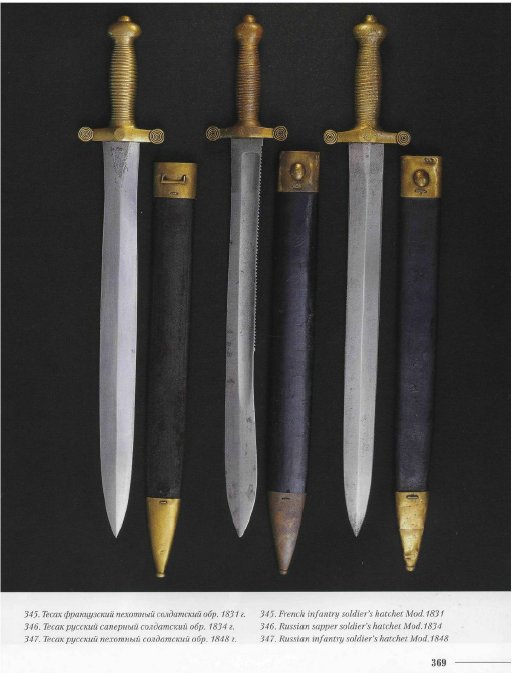
from A. N. Kulinsky, European Edged and Staff Weapons
"In addition to being efficient, all pole arms were quite nice to look at." - Cherney Berg, A hideous history of weapons, Collier 1963.
|
|
 |
|
Glen A Cleeton

|
| Posted: Sat 02 Jan, 2016 3:10 pm Post subject: |
|
|
Both the wiki and Chuck's A2A blurbs are flawed in large measure.
The 1831 was issued more to the infantry, not listed as artillery. The 1816 has three fullers and a broader blade. The 1831 reflects an "improvement" in handling. The US 1832 was indeed a copy of the 1816 French sword. The 1831 blade more akin to the US 1841 cutlass. The French glaives go back at least to the 1771 model artillery sword.
Other countries (as noted) had similar swords and I am almost certain the sword in the initial post is not a French sword but the pictures leave a lot to imagine..
cheers
GC
|
|
|
|
|
|
|







 This is a standard topic