| Author |
Message |
Luka Borscak

|
 Posted: Fri 20 Mar, 2009 6:14 am Post subject: Double fullered viking swords? Posted: Fri 20 Mar, 2009 6:14 am Post subject: Double fullered viking swords? |
 |
|
|
Oakeshott mentioned in the Records of the medieval sword that some fine viking swords had double fullers. I haven't seen one and in The swords of the viking age is also not one double fullered viking sword. Does anybody have a picture of such a weapon or have maybe seen it somewhere?
|
|
  |
 |
D. Bell

Location: New Zealand Joined: 30 Apr 2004
Posts: 73
|
| Posted: Sat 28 Mar, 2009 2:09 am Post subject: |
|
|
This is something I've wondered about too, as I'm a fan of both viking age swords and double fullers. I've seen a lot of pictures of viking age swords, but none that have double fullers, so if they did exist they certainly weren't common. If anyone does know of a double fullered viking sword I would also be quite interested to hear about it.
An armed society is a polite society.
|
|
|
|
|
Jared Smith

|
| Posted: Sat 28 Mar, 2009 5:41 am Post subject: |
|
|
There is one that appears to be double fullered in the photograph, although that is not really discussed in the narrative, near the back of Swords of the Viking Age. Its a type X, 10th century, JPO 2253, page 118 in my 2002 printing. It was also pattern welded with some remaining silver wire just under the pommel. It's possible that the fullers were added later, as the blade was broken and re-welded 30 cm from the tip. Given the "viking era" guard still remains, I doubt it was rehilted at much later period though.
Absence of evidence is not necessarily evidence of absence!
|
|
|
|
|
Luka Borscak
|
| Posted: Sat 28 Mar, 2009 6:27 am Post subject: |
|
|
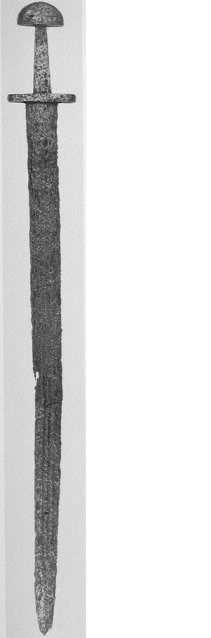
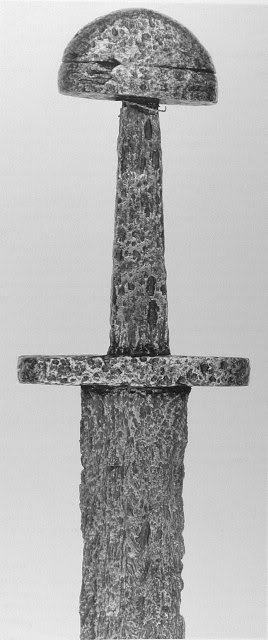
This is the sword you are talking about. I saw that picture earlier but didn't notice that it looks like it might be double fullered. It is visible only in the lower part of the blade.
|
|
|
|
|
Jared Smith
|
| Posted: Sat 28 Mar, 2009 7:11 am Post subject: |
|
|
That is the one. Anyhow, the double lines jumped out at me as pretty unique for the date when I saw the photo. I wondered why they were not discussed as this is the only feature like that in the photographed examples from the era that I can recall being shown in either of the two texts it seems that we have both been studying.
I wonder if the author doubted the providence of the double lines, and chose not to comment on them on purpose. The sword strikes me as a little odd. The grip seems longer than normal for the date assigned, and the fullers are sharp only in the lower tip section of the blade. It is stated that the blade had corroded evenly. I would have expected the fullers to corrode faster near the tip if they were original and gradually tapering as the rest of the blade appears to be. (They may be more like incised lines such as on some Roman era spathas. Or, I suppose the remaining furniture and upper blade portion of an older broken blade could have been welded to a broken tip of a newer fullered blade around 11th -12th century.)
Absence of evidence is not necessarily evidence of absence!
|
|
|
|
|
Dan Dickinson
Industry Professional

|
| Posted: Sat 28 Mar, 2009 7:55 am Post subject: |
|
|
Hmmm....it does appear to be a double fuller on first glance. However, I would imagine that Pierce would mention something
about such an apparently unusual feature. My suspicion is that rather than a double fuller we are seeing the "two central bands of pattern welding" and that the dark line is the intersection of the two bands rather than a central ridge.
Dan
|
|
|
|
|
|
Patrick Kelly
|
| Posted: Sat 28 Mar, 2009 8:50 am Post subject: |
|
|
|
There's also the possibility that it's a much older blade that was reused in the "viking" era. There are celtic iron age blades that feature double fullers with a general profile not unlike that blade. I'm not saying this is a personal theory but rather a possibility, although I think Dans explanation is more likely.
|
|
 |
|
Jared Smith
|
| Posted: Sat 28 Mar, 2009 11:22 am Post subject: |
|
|
| Dan Dickinson wrote: | | My suspicion is that rather than a double fuller we are seeing the "two central bands of pattern welding" and that the dark line is the intersection of the two bands rather than a central ridge. |
I doubt that there is no geometric aspect to the lines. Without X-ray type examination, pattern welding can be difficult to discern at all after corrosion occurs. (It was stated that corrosion had occurred on this one.) Even relatively new blades with pattern welding can lose visible contrast bands of pattern welding contrast within a few months if not kept oiled. (I have had to have some pocket knifes re-etched, which is not a problem since the maker is a short drive away.)
Absence of evidence is not necessarily evidence of absence!
|
|
|
|
|
Chuck Russell

|
| Posted: Sat 28 Mar, 2009 6:29 pm Post subject: |
|
|
|
M C Bishop has some 3rd c AD blades with double fullers shown in his book Roman Military Equipment
|
|
  |
|
Dan Dickinson
Industry Professional
|
| Posted: Sat 28 Mar, 2009 6:55 pm Post subject: |
|
|
| Jared Smith wrote: | | Dan Dickinson wrote: | | My suspicion is that rather than a double fuller we are seeing the "two central bands of pattern welding" and that the dark line is the intersection of the two bands rather than a central ridge. |
I doubt that there is no geometric aspect to the lines. Without X-ray type examination, pattern welding can be difficult to discern at all after corrosion occurs. (It was stated that corrosion had occurred on this one.) Even relatively new blades with pattern welding can lose visible contrast bands of pattern welding contrast within a few months if not kept oiled. (I have had to have some pocket knifes re-etched, which is not a problem since the maker is a short drive away.) |
While it might be true that corrosion might diminish the appearance of pattern welding in a polished blade....it can also serve to show the pattern when it advances far enough (due to the iron and steel having slightly different rates of corrosion). I believe this is the case with this sword as Pierce states: "The corrosion has occurred uniformly and thus allows us to see, with some clarity, the structure of blade, its central section and both cutting edges. It does appear that
we have an excellent example of the bloditha style of pattern-welding through the central
portion of the blade."
Dan
|
|
|
|
|
Luka Borscak
|
| Posted: Sun 29 Mar, 2009 3:39 am Post subject: |
|
|
|
It does sound like Ian Pierce thinks of that what we see as fullers when he writes about pattern of pattern welding. And he writes with enough detail that he would mention the possibility of double fullers if it looked that way in real.
|
|
|
|
|
Luka Borscak
|
| Posted: Mon 24 Jan, 2011 3:39 pm Post subject: |
|
|
It's alive!!! (The topic.  ) )
Finally, a double fullered viking age sword appeared, and photos are of good quality, so I think there is not much doubt it really is double fullered.
Bottom of the page 15 and top of the page 16:
http://www.vikverir.no/ressurser/hist_mus_osl...mp;page=15
|
|
|
|
|
J.D. Crawford

|
| Posted: Mon 24 Jan, 2011 5:15 pm Post subject: |
|
|
|
Good one Luka - I've often wondered about this, and those pictures are the first solid proof I've seen. -JD
|
|
 |
|
Luka Borscak
|
| Posted: Tue 25 Jan, 2011 6:34 am Post subject: |
|
|
|
I'm not really sure what type it is, Petersen type 1, D, V, what would you guys say?
|
|
|
|
|
|
Audun Refsahl
Location: Norway Joined: 15 Feb 2006
Posts: 82
|
| Posted: Tue 25 Jan, 2011 7:51 am Post subject: |
|
|
that sword is located at Kulturhistorisk museum in oslo.
I found a couple of swords that has other abnormal cross sections, allthough not double fullers.
this one is located at "Midgard historiske senter", at Borre in Norway. the sword wasn't found at borre though. look at the fuller on the one to the left:) http://www.vikverir.no/ressurser/borre_no/
the other one nils just showed me, is at Kulturhistorisk in oslo, look at picture nr 4. this single edged sword has no fuller at all..
edit: maybe I should add the link... http://www.vikverir.no/ressurser/hist_mus_osl...amp;page=5
just bacon...
|
|
|
|
|
|
Nils Anderssen
Location: Drammen, Norway Joined: 08 Dec 2005
Posts: 61
|
| Posted: Tue 25 Jan, 2011 1:02 pm Post subject: |
|
|
|
It is also worth notising that the double fullers on the sword at the Kulturhistorisk museum in Oslo stops a little bit before half way down the blade. After that they fade out into one fuller.
|
|
|
|
|
Luka Borscak
|
| Posted: Tue 25 Jan, 2011 3:33 pm Post subject: |
|
|
| Audun Refsahl wrote: | that sword is located at Kulturhistorisk museum in oslo.
I found a couple of swords that has other abnormal cross sections, allthough not double fullers.
this one is located at "Midgard historiske senter", at Borre in Norway. the sword wasn't found at borre though. look at the fuller on the one to the left:) http://www.vikverir.no/ressurser/borre_no/
the other one nils just showed me, is at Kulturhistorisk in oslo, look at picture nr 4. this single edged sword has no fuller at all..
edit: maybe I should add the link... http://www.vikverir.no/ressurser/hist_mus_osl...amp;page=5 |
That's pattern welding on the middle blade? Looks very nice. And the one with snake inlay is very cool.
|
|
|
|
|
Luka Borscak
|
| Posted: Tue 25 Jan, 2011 3:34 pm Post subject: |
|
|
| Nils Anderssen wrote: | | It is also worth notising that the double fullers on the sword at the Kulturhistorisk museum in Oslo stops a little bit before half way down the blade. After that they fade out into one fuller. |
I didn't notice that. Have you seen a full length photo maybe or you met it in person?
|
|
|
|
|
|
|







 This is a standard topic