Chad Arnow
myArmoury Team


|
 Posted: Thu 20 Aug, 2026 4:58 pm Post subject: Tod?s Workshop Spider Web Quillon Dagger Posted: Thu 20 Aug, 2026 4:58 pm Post subject: Tod?s Workshop Spider Web Quillon Dagger |
 |
|
Introduction
Museums often contain more artifacts than can be displayed at any given time. Such is the case at the Royal Armouries in the United Kingdom. Their searchable online database yields a total of over 65,000 items, including things like documents and books; limiting the search to items on display yields fewer than 11,000 items. Among the items not on display is a unique dagger they have dated to the 15th century. Found under the floor of Crosby Hall (an historic London building built in the 15th century and moved to its current location in 1910), it has a hilt that has so far proven to be unique among extant medieval daggers.
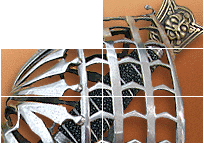
The hilt consists of a cast brass guard and pommel. The guard, with pierced and split quillons, is generally similar to at least two other known examples. The pommel, eight-sided in form, appears to be unique. Both are covered in the remains of intricate engraved lines. On the pommel, these begin to take the form of a spider?s web. The dagger?s current condition (perhaps over-cleaned) has washed out the detail of some of these lines, but enough remains to give an idea of the pattern. The blade is long and single-edged. Its spine features sections that alternate between being flat and beveled, producing a cross-section that changes from wedge-shaped to kite-shaped and back again. This cross-section, while not often seen in modern reproductions, exists on a number of daggers, including several in the Royal Armouries collection.
Leo Todeschini (known as Tod) makes replicas of this dagger under the Tod?s Workshop banner. By using high-resolution photos and manipulating their color and contrast to see what remains of the design, Tod has recreated the engraved lines to reflect, as much as possible, the dagger hilt?s original condition. The Royal Armouries dagger has an engraved section on one side of the blade near the base with traces of gilding that has not been reproduced here.
Overview
Leo ?Tod? Todeschini has been producing high-quality replicas arms and medieval wares for many years. With a varied background that includes engineering experience in front of and behind the camera for television productions, Tod has supplied weapons and other items for television shows, movies, and historical sites in addition to collectors and reenactors. Operating both a production company, Tod Cutler (formerly the English Cutler), and his custom shop, Tod?s Workshop (formerly Tod?s Stuff), he continues to churn out attractive, functional, well-crafted items for a variety of budgets.
The dagger that is the subject of this review was purchased second hand and appears to have been one made for stock, not to order. As such, comments about things like the commissioning process for this piece are not ones I can make from a firsthand perspective. However, I have been buying items from Tod?s various enterprises for more than a decade and have yet to have a poor experience. For much of the past decade, Tod?s pieces have usually outnumbered any other brand in my collection.
Measurements and specifications:
Weight: 10.875 ounces
Overall length: 17 3/8 inches
Blade length: 12 5/8 inches
Blade width: 1 inch at base, tapering to 3/8 inch
Grip length: 3 inches
Guard width: 2 ? inches
Replica created by Tod?s Workshop of Oxford, UK
Handling Characteristics
With a blade over a quarter inch thick at the base, this dagger has some heft to it. It is not, however, sluggish or unresponsive in any way. Held with the point up, it feels more authoritative in the cut than many other daggers I?ve owned. Thrusts in that grip are easy to do as well. In the point-down, so-called icepick grip, it would deliver devastating thrusts. The blade is sharp and was easily touched up to a very sharp edge, but the thickness of the blade near the hilt means that cuts are better executed toward the tip.
The leather-wrapped grip measures at three inches; my palm at closer to four. The size, though, is both historical and comfortable. I firmly believe that many historic dagger hilts are designed to have the guard and/or pommel used as part of the grippable surface. Held point-up, the pommel of this dagger sits by the heel of my hand while the guard locks in between thumb and index finger. Combined with the shape of the grip, they help keep the dagger?s edge aligned by preventing the dagger from rotating. Held point-down, the pommel and guard switch places but provide the same level of security. The guard provides plenty of protection to the hand in either grip.
Fit and Finish
As with other pieces I?ve owned by Tod, this one exhibits a historical appearance I have come to prize. It is well-made, but exhibits elements of hand-crafting that make it unique and authentic. The castings, bronze rather than brass, are extremely well-done, and are packed with detail. There is a hint of a casting flaw on one side of the pommel that doesn?t detract from the overall look. The grip is of carved wood with three risers; it has been wrapped in black leather and given a cord impression on top. The seam of the leather is visible but not obtrusive.
The long blade features a satin finish with a small scattering of file marks and scratches that have been present on all blades I?ve seen by Tod. While these could be ground out, that would likely lead to a more modern look and finish than Tod intended. On one side, the blade features a copper-inlaid mark. Upon close inspection, it appears to be two partial, overlapping strikes of Tod?s four-segmented circle hallmark. The original had a brass-inlaid mark; the copper used here is a nice contrast to the rest.
The scabbard is of two layers of leather, dyed black. It features a section of stamped decoration near the top and lines that run down the front near the edge. It fits the blade well: the blade doesn?t fall out easily but is easy to draw. A twisted cord is threaded through the top and can be tied to a belt. The scabbard is completed with a cast bronze chape that is part of the lineup for sale through Tod?s production enterprise, Tod Cutler. The scabbard is well-made throughout.
Conclusion
Daggers have been a significant part of my collection for many years and I often gravitate toward items that are more unique. This piece fits the bill: it is based off a unique historical example, is well-made, and is eminently functional. It looks great and feels just as good in the hand. I?m pleased to have it in my collection.

ChadA
http://chadarnow.com/
|
|







 This is a standard topic


