| Author |
Message |
Harry Marinakis

|
Posted: Mon 30 Jun, 2025 4:40 am Post subject: Neil Burridge Bronze Rapier - need suggestions |
|
|
Been a long time since I posted anything, a few years, but I'm back. Sorry I haven't responded to any messages.
I have a bronze sword project, and I am in need of ideas & suggestions.
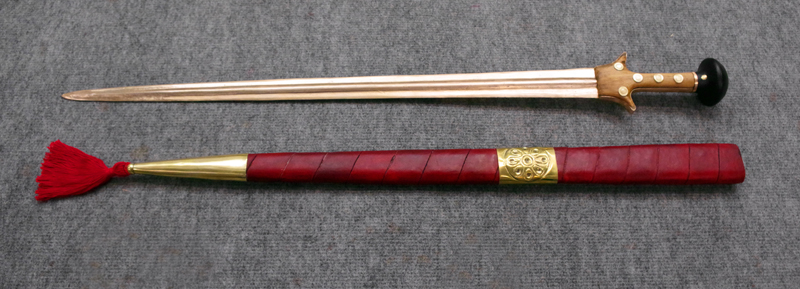
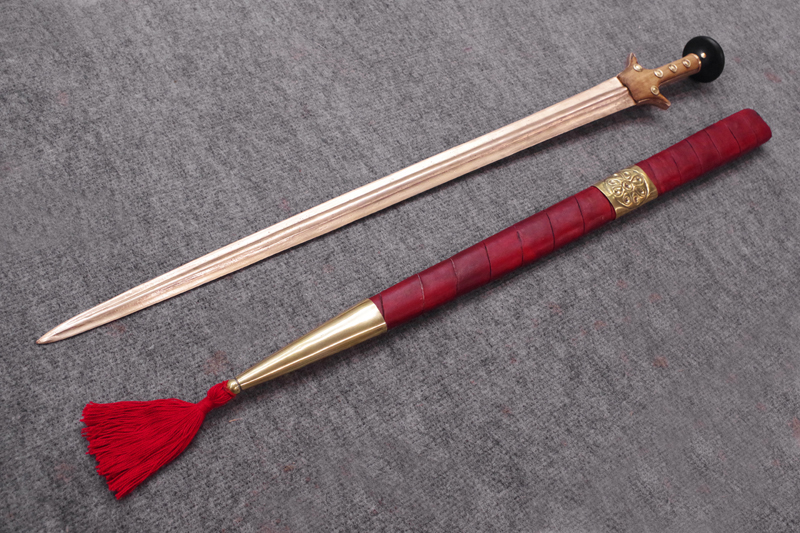
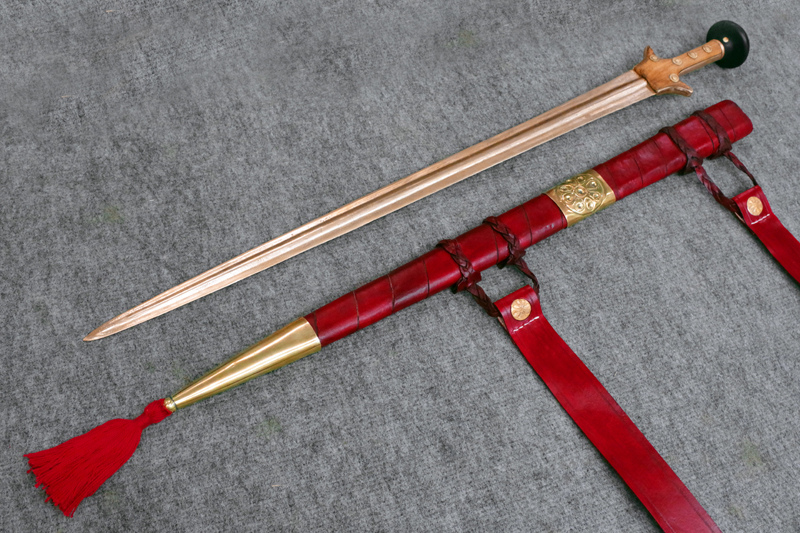
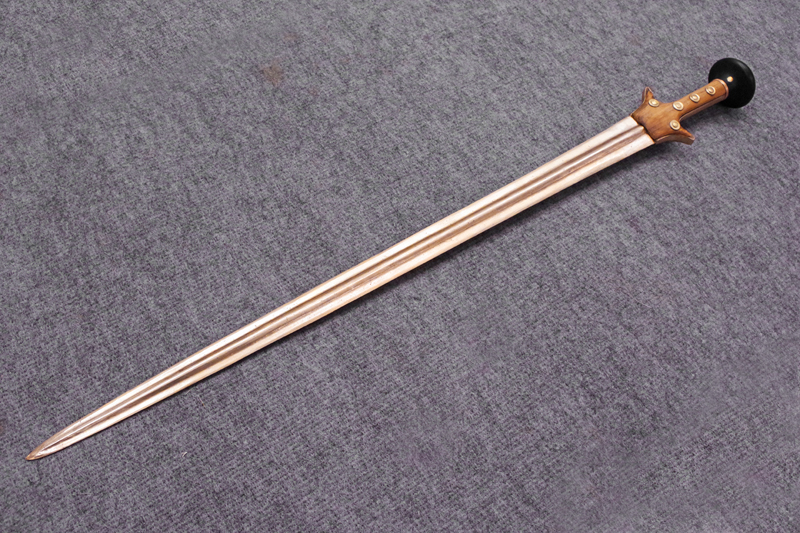
I've had this Neil Burridge bronze rapier sitting around for almost 10 years, and I finally decided to do something with it. It is a Mycenaean Type Ci rapier. I obtained it from Neil when this sword was still in the development phase, and it came to me rough from the mold.
A little background of the process to get to this point, then I'll pose my question(s).
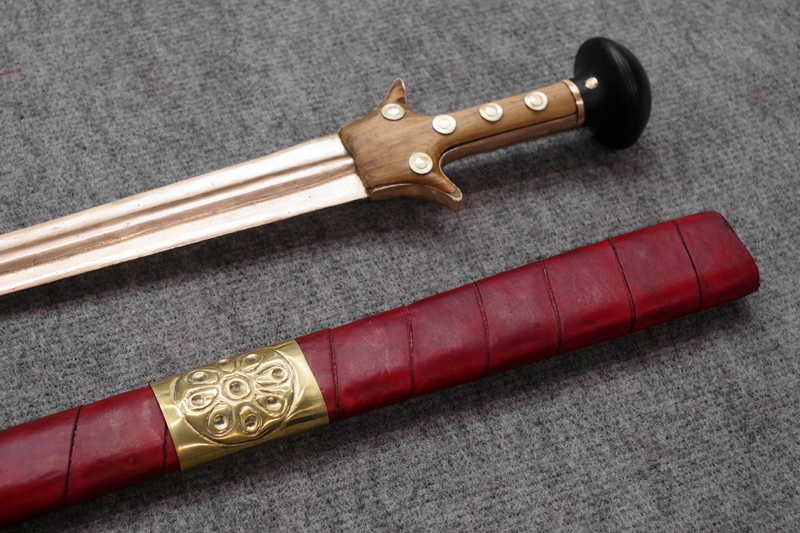
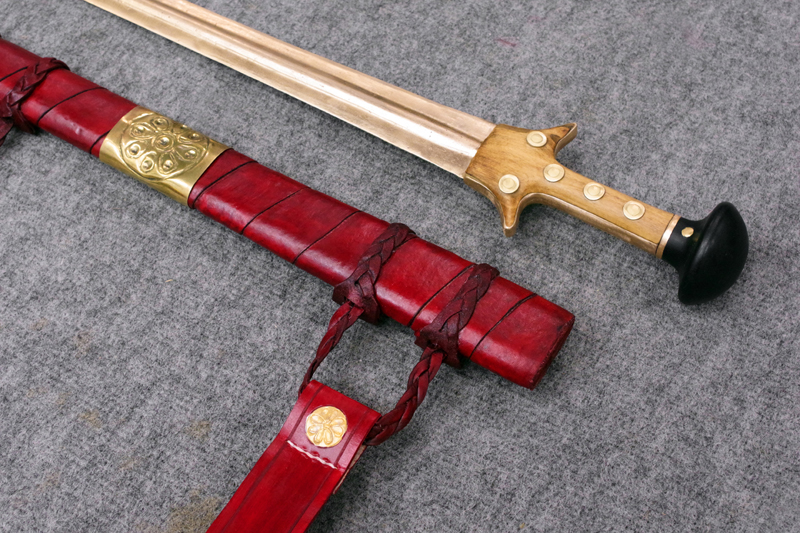
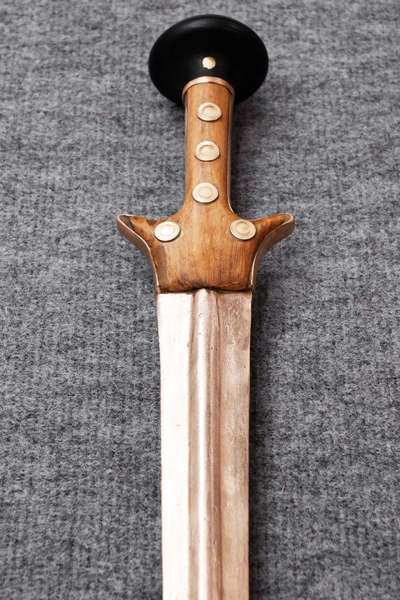
The original pommels were marble or ivory, neither of which I have, so I turned the pommel from African Ebony.
I used Greek Olive wood for the handle scales. I glued the scales to the handle and drilled the holes for the handle pins. Unfortunately, when I started rasping the handle to shape I broke into some large worm holes. So I had to patch and fill-in the holes. I used brass pins and washers instead of gold.
Neil Burridge Mycenaean Type Ci Rapier
OAL 30-5/8"
Blade length 24-5/8"
POB 4-7/8"
Weight 25.4 oz.
OAL 77.8 cm
Blade length 62.5 cm
POB 12.4 cm
Weight 719 g
The scabbard... Well, we all know that distinct lack of detailed information about Bronze Age scabbards. For this project I pieced together a scabbard using a variety of source. Very thin wood core, spiral leather wrap, brass locket with chasing, chape with a tassel.
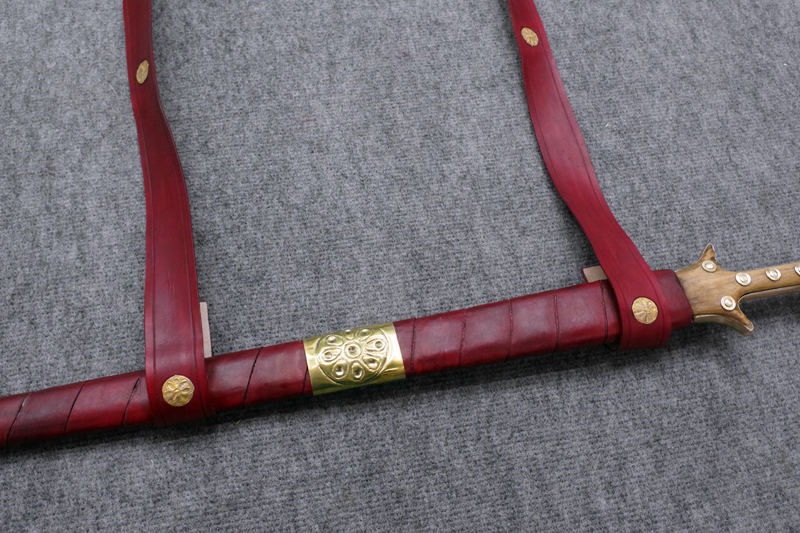
I am stuck on the baldric strap. I made a 1-1/2 inch wide strap. I was going sew the strap onto the scabbard as shown, but that seems decidedly unsatisfying.
Got any ideas?
I was thinking of making a brass locket at the the throat with a ring behind the scabbard and hanging the scabbard vertically. Or even making two brass lockets to hang the scabbard more horizontally instead of the sewing the straps. I'd do this, but I don't see any evidence for rings on lockets.
Ideas? Suggestions?
One last question. I left the blade somewhat unfinished. I spent a lot of time grinding and polishing, but there are still a lot of pits and imperfections. How finished were these blades? Should I keep polishing, or leave it alone?
Attachment: 206.73 KB

Attachment: 369.2 KB

Attachment: 359.27 KB

Attachment: 385.1 KB

|
|
|
 |
Harry Marinakis

|
Posted: Tue 01 Jul, 2025 12:27 pm Post subject: |
|
|
I had a EUREKA! moment, and used mystery braids around the scabbard, to which I attached the baldric straps.
The project is complete.
Attachment: 403.15 KB

Attachment: 428.92 KB

Attachment: 443.66 KB

Attachment: 234.65 KB

|
|
|
 |
Chad Arnow
myArmoury Team


|
Posted: Tue 01 Jul, 2025 2:35 pm Post subject: |
|
|
Harry,
Good to see you again. While this is outside the periods I study, it looks great!
ChadA
http://chadarnow.com/
|
|
|
 |
Dan Howard

|
Posted: Fri 04 Jul, 2025 5:26 am Post subject: |
|
|
Looks good to me. Neil does wonderful work. The tassel is a neat interpretation of the "knob" that we see on the bottom of scabbards in some illustrations. Illustrations show these swords being carried on a shoulder strap with the grip up high near the armpit. My guess is that it would make it easier to draw while carrying a large shield.
I'm not sure how much polishing is needed for the blade. We don't really know how smooth the original ones were since all extant examples have been in the ground for thousands of years. Anyone who owned one of these swords would have had a household full of servants to polish these things for him.
Author: Bronze Age Military Equipment, Pen and Sword Books
|
|
|
 |
Leo Todeschini
Industry Professional

|
Posted: Sat 05 Jul, 2025 12:03 pm Post subject: |
|
|
Hi Harry,
Looks great and as with Chad, I know little about this period, but your solution looks great and is very plausible.
As regards the blade finish, again I cannot say for sure, but I am basically with Dan. Looking at period pieces from any period, a full polished finish appears to be common, but that does not mean it was like a modern flawless mirror. Casting pits, porosity, slag inclusions are all going to be issues on most castings. Many of which cannot be polished or ground out without removing a compromising amount of material. It would just have a been a fact of life that a piece like this may well have 99.5% perfection of finish, but the other 0.5% cannot be made perfect without ruining the piece. So you live with it.
This was certainly the case on many/most medieval weapons and armour where I am more familiar.
Tod
www.todsworkshop.com
www.todcutler.com
www.instagram.com/todsworkshop
https://www.facebook.com/TodsWorkshop
www.youtube.com/user/todsstuff1
|
|
|
 |
Harry Marinakis

|
Posted: Thu 10 Jul, 2025 8:29 am Post subject: |
|
|
| Dan Howard wrote: | | Looks good to me. Neil does wonderful work. The tassel is a neat interpretation of the "knob" that we see on the bottom of scabbards in some illustrations. |
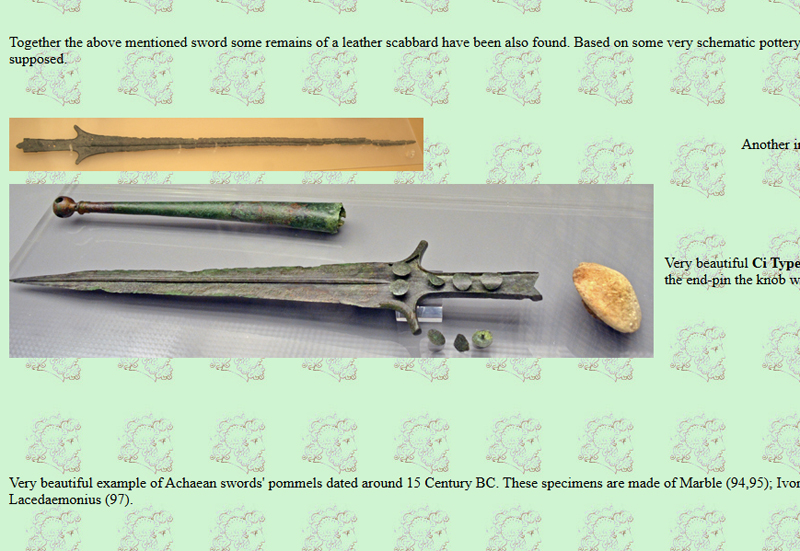
I wasn't trying to reproduce the "knob," I was using this reference of a Type Ci rapier (just like mine) that showed a chape with a ball at the end with fringe.
EDIT: You mean the stubby wing-like knob like with iron-age chapes?
The caption for the illustration:
"Very beautiful Ci Type sword with ivory pommel and relevant sheath bronze end-pin from Aiani tomb 22 dated 14th century BC. Note on the end-pin the knob with the hole for the fringes as also attested on some pottery representations."
| Dan Howard wrote: | | Illustrations show these swords being carried on a shoulder strap with the grip up high near the armpit. My guess is that it would make it easier to draw while carrying a large shield. |
Yeah, I wasn't sure if this was real or just an artist's attempt to show motion and fluidity in the illustration. You know, as someone runs that light sword bounces and swings out more horizontally. But I went with it, and my baldric strap is fairly short so that the rapier hands rather high. Not quite in the airpit, but much higher than, say, a medieval sword on a baldric.
Attachment: 401.64 KB

|
|
|
 |
Dan Howard

|
Posted: Sun 13 Jul, 2025 12:41 am Post subject: |
|
|
This is the first time I'm seeing a Mycenaean scabbard with a knob on the bottom of it. It clarifies a lot of their illustrations. Knobbed scabbards seem to have been common based on how many times they are depicted. One good example is the Pylos Agate; there are two being shown here.
Author: Bronze Age Military Equipment, Pen and Sword Books
|
|
|
 |
Matt Corbin

|
Posted: Thu 07 Aug, 2025 4:51 pm Post subject: |
|
|
Beautiful sword/rapier. Congratulations. Neil does the absolute best bronze work anywhere.
?This was the age of heroes, some legendary, some historical . . . the misty borderland of history where fact and legend mingle.?
- R. Ewart Oakeshott
|
|
|
 |
|
|
You cannot post new topics in this forum You cannot reply to topics in this forum You cannot edit your posts in this forum You cannot delete your posts in this forum You cannot vote in polls in this forum You cannot attach files in this forum You can download files in this forum
|
All contents © Copyright 2003-2026 myArmoury.com All rights reserved
Discussion forums powered by phpBB © The phpBB Group
Switch to the Basic Low-bandwidth Version of the forum
|