Samurai with a otsuchi (war mallet)
[ Linked Image ]
Samurai with various weapons, otsuchi, kanabo, and ono.
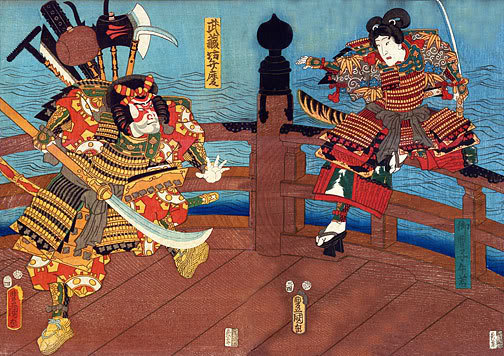
Samurai with kanabo.
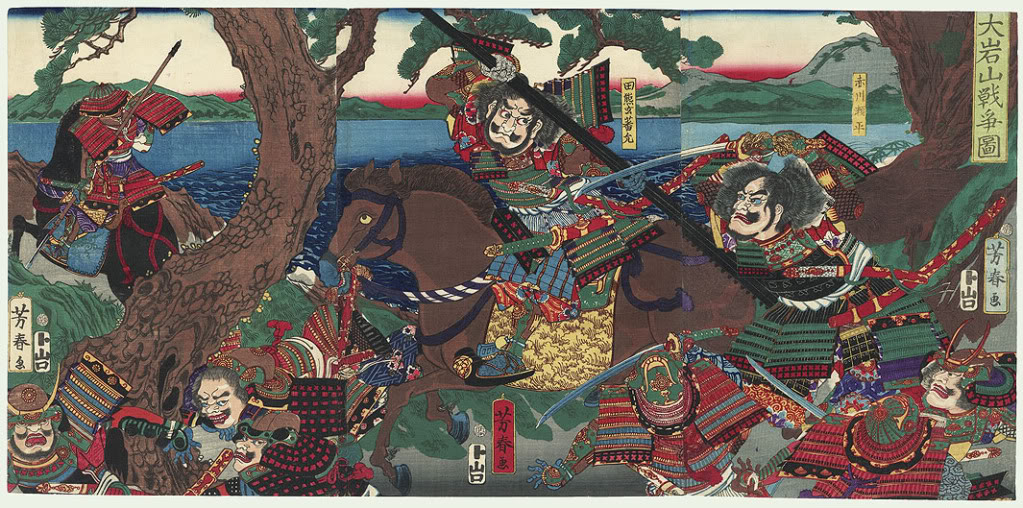
Samurai with a ostsuchi
| Moses Jones wrote: |
| I think the 5'10" 180 lb average spartan would have a significant advantage over a 5'3" 130 lb average samurai. But personal skill and luck is what will determine the real winner. |
| Dan Howard wrote: |
| It is irrelevant to the outcome of a battle if one or two samurai used unusual weapons. It is also not helpful to trawl through the sources to find exceptions that make this discussion even harder to follow. The only way this topic can make any sense at all is to analyse typical warriors from both cultures. |
| Quote: |
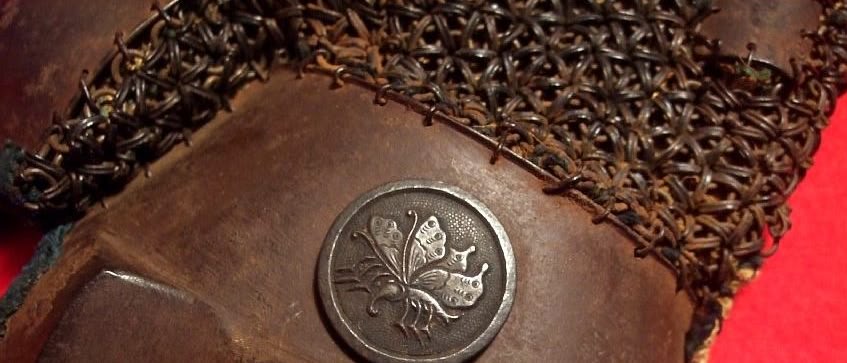
| Kusari almost never existed alone. Rather, it was used to fill all the gaps between the scales on the kote and suneate, or to connect them. Usually, it was sewn to the foundation fabrics or leather, or placed between two layers. Only in few cases was the kusari used as a basic protection—such as the secondary areas of the armour or as a shikoro in some mass-produced helmets6, etc |
| William P wrote: |
|
they didnt even take to the idea of riveting maille and using it to protect gaps in the armour. thanks to my 20/20 21st C hindsight this looks like an unthinkablystupid idea., but i get the feeling they had their rreasons.. |
| Quote: |
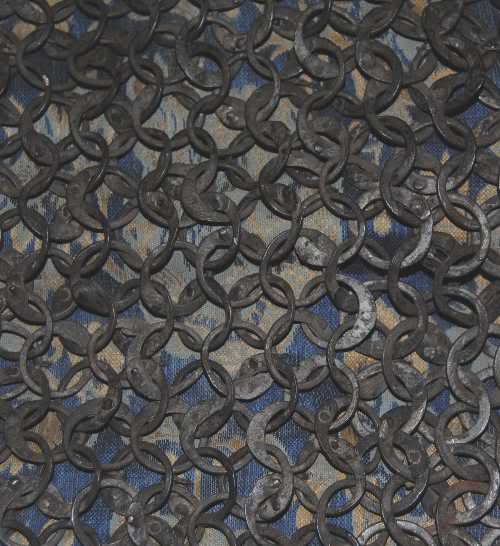
| Riveted kusari was known and used in Japan. In the book Japanese Arms & Armor Introduction By Robinson, H Russell NA on page 58 there is a picture of Japanese riveted kusari,[12] and according to this translated reference from Sakakibara Kozan's 1800 book, The Manufacture of Armour and Helmets in Sixteenth Century Japan, the Japanese not only knew of and used riveted kusari they manufactured it as well.
karakuri-namban (riveted namban), with stout links each closed by a rivet. Its invention is credited to Fukushima Dembei Kunitaka, pupil, of Hojo Awa no Kami Ujifusa, but it is also said to be derived directly from foreign models. It is heavy because the links are tinned (biakuro-nagashi) and these are also sharp edged because they are punched out of iron plate. |
| Quote: |
| Training a hoplite concentrated on formation drills, whereas training a samurai included a huge amount of single combat work. |
| Michael Curl wrote: |
| Isn't the riveted clearly a European borrow? Its called nanban after all isn't it? So wouldn't that mean that their was no riveted mail until after European arrival? |
| Gary Teuscher wrote: |
| The 5'10" 180 lb Spartan comment seemed a bit off also.
But from what I have researched, a Spartan was probably a hair taller than the 5'5" Roman, most estimates put average height in the 5'7" range. Perhaps better nutrition for being a warrior-elite helped, and Spartans DID do some selective breeding, though it was more weeding out the unfit, not breeding for size, and it was in plave for only a short period of time when you look at it in a geneological time frame. |
| Quote: |
| I see 5'7" bandied about as the height of the average Greek but that's not right, either. That would have made the Greeks more or less the tallest people on earth at the time. |
| Riki K wrote: | ||
The most common figure I've seen for the height of the average Roman Imperial legionnaire is 5'4". I've seen estimates for historical heights all around the same range. I see 5'7" bandied about as the height of the average Greek but that's not right, either. That would have made the Greeks more or less the tallest people on earth at the time. |
| Eric S wrote: |
| It was only recently that some samurai armor was actually tested to see if the Japanese used steel or just iron in making their armor. Try finding that information in any of the old standard western reference books, you wont because it was not proven until very recently that the Japanese did use steel along with iron plates in their armor......but now in a new book on samurai armor by Trevor Absolon that just came out there is actual a chapter called "Iron or Steel" were the subject of steel in samurai armor is throughly discussed including the conclusive 2005 test at the Royal Armouries of Leeds. Here is a link to page 16.
"The Watanabe Art Musuem Samurai Armour CollectionVolume I ~ Kabuto & Mengu, author Trevor Absolon" http://books.google.com/books?id=8APyY3eIONcC...amp;f=true |
| Quote: |
| Michael Curl wrote:
Isn't the riveted clearly a European borrow? Its called nanban after all isn't it? So wouldn't that mean that their was no riveted mail until after European arrival? not only that but most sources that mention nanban gusari note that they still kept it butted OR like keychain rings, then again someone on a thread about antique axes showed me an example of a antique battleaxe |
| Riki K wrote: | ||
The most common figure I've seen for the height of the average Roman Imperial legionnaire is 5'4". I've seen estimates for historical heights all around the same range. I see 5'7" bandied about as the height of the average Greek but that's not right, either. That would have made the Greeks more or less the tallest people on earth at the time. |
| Gary Teuscher wrote: | ||
These type of comparisons can be almost silly sometimes. We are talking technologically a difference of about 2,000 years - may as well ask who would win, a Special forces platoon ro a group of Aztec warriors.
I must say though that this paints Spartan Hoplites in a bad light, and I disagree. Maybe Hoplites getting rudimentary training get this - but with the training we know Spartans had, I'm sure they were not only adept in formation fighting but also in more one-on-one. I look at a Spartan more like a middle ages knight - as the warrior-elite of the culture, they spent much of their time training, and not just for large scale formation battles. From what we know they were also effective in small unit actions and raiding as well. The technology would favor the Japanese though of course. The 5'10" 180 lb Spartan comment seemed a bit off also. But from what I have researched, a Spartan was probably a hair taller than the 5'5" Roman, most estimates put average height in the 5'7" range. Perhaps better nutrition for being a warrior-elite helped, and Spartans DID do some selective breeding, though it was more weeding out the unfit, not breeding for size, and it was in plave for only a short period of time when you look at it in a geneological time frame. |
| Michael Curl wrote: |
|
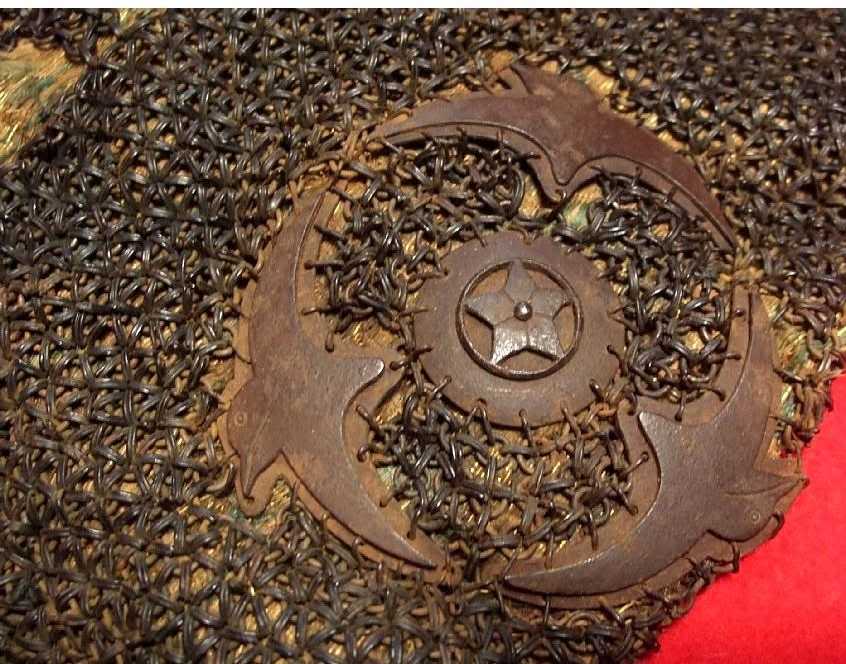
Isn't the riveted clearly a European borrow? Its called nanban after all isn't it? So wouldn't that mean that their was no riveted mail until after European arrival? not only that but most sources that mention nanban gusari note that they still kept it butted OR like keychain rings, Nanban would not be butted, that's what makes it nanban. Nanban means southern barbarian and was the period term for European, since no European mail was butted (there have been enough arguments to proof that) and they are calling this type of riveted 4-1 mail nanban, I would assume that it was from Europe or a European style (as perceived by the Japanese of course). I don't see how they could have butted it and called it nanban, unless they were referring to the all circle pattern (as opposed to the Japanese circle oval pattern). So I doubt that it would be butted or keychain style IMHO. |
| Quote: |
| Not the time period in question, though average height in medieval England was about 5'8 for men and 5'3 for women.
Greeks, Romans, and most of the famous ancient civilizations were Mediterranean people, and would have averaged shorter than the rest of Europe. |
| Quote: |
| Based on the length of long bones, the average height of men buried in Italy from -V to +V was 168 cm (66"). Greek heights were similar (around 170-172 cm according to Lawrence Angel). Young, free men fit for military service would have averaged slightly higher. So the average Iron Age Italian was taller than the average Italian conscript until 1956, and the average Dutch conscript before 1920! (G. Kron, Historia, Vol. 54 No. 1 (2005)) |