Go to page Previous  1, 2

Christopher Gregg wrote:
Matt Easton wrote:
p.s. In my researches I found a will describing 'an old sword' worth 1d (one penny). The most basic English soldier of the time was paid 3d per day, and trained archers were often paid 6d per day. So at that time in England an archer could have afforded to buy 6 swords every day! Swords could be got cheap, there was no need or demand for any sword maker to be making crap swords.


Even with the reference, I find the economics of this incomprehensible. If an archer or basic soldier is paid daily enough to buy, at retail, three swords, what does this say about the sword maker's wages? If he has to make three swords in ONE day, just to equal the wages of a mere soldier, possibly lightly or barely skilled, then it would make more sense for the sword maker to quit making swords and become an archer or soldier! I mean, ask any sword maker on this list if he can make a decent sword in just one day, much less at least three!


As said, this is a used sword. Value is of course subjective. Maybe 1d was a "yard sale" price. It does not imply that one could actually buy 1d sword at every street corner, or that there was a market for these swords.

For instance, let's say I put the shoes below in my will valued at 1 euro. New they may have been worth 100 euro's...
[ Linked Image ]

Btw good to see you again Matt!
FWIW, this is from my article on Swords in the Virginia Muster, 1624-25:

Samuel Purchase's 1622 list of the goods colonists should bring with them recommends one sword at a cost of 5 shillings—the same price as the two iron skillets he recommended, half the price of one heavy wool suit and just under one-third the price of one "compleat, light" armour. By contrast, a musket was very expensive at 1£, 2s.

These most likely would have been munition-grade swords, and I think it's very helpful to see the comparison to other common items--especially the skillets.
Was there an inheritance tax at this time? Maybe the sword described in the will was intentionally undervalued. Just a thought.
Scott,

Not really on items of this type generally speaking... but. There sort of is for lands etc., things of high, high value. Of course this is England. Sometimes there were taxes on general wealth including goods you can move, so I guess it was possible.

I really think there is too much evidence in port books and brokage books for various towns that indicate a wide price range of new swords. As I said earlier I have no idea the exact difference but it is not just old or second hand swords being bought used but new swords that are less expensive. Same goes with armour.

Since there were many levels of craftsmen why is this a surprise. We have loads of masters marking stuff and then loads of things without such marks. My guess is that the semi-massed produced items are unmarked by a masters mark and were cheaper. That said I still do not know if the blade itself was of lesser quality or whatnot, only that there were many grades of new blades at different prices.

RPM
One question of course is what a new "munitions grade" sword would be like.

Of course there is a noticeable difference between "normal" quality swords and "high" quality swords. This can also easily be seen in the archaeological record as well as in museums.

But I think that, for one thing, really bad quality swords could not be made due to the guild structure which did set a minimum standard especially in the later middle ages. So most of the swords made were probably made according to such a minimal standard, meaning that one would get a no-frills weapon. Since this would still be a relatively expensive item for which a large percentage of the population had no real need, many would use hand-me-downs as evidenced in the picture by Dürer.
I would guess that the minimum standard would be made faster but to roughly the same tolerances of fit as finer pieces. Big time savings in finishing and details, though. I've seen several examples of artwork that show low-ranking militia-type thugs with scabbards lacking chapes. If we had all examples ever made in a given period I wonder if we might see some common themes in terms of pommel and cross, as one would expect the cutler/smith to use those forms that are easiest to make.
It's interesting that the cache of swords found in the river Dordogne, near Castillon has not come up in this discussion yet. Could they not be regarded as 'munitions grade' swords?

[ Linked Image ]

They are all of three distinct 'standard' designs, evidently made by the same workshop(s). They were found crated up and without scabbards. Some also display evidence of being well used (abused?). Oakeshott says that they were of 'essentially "knightly form and quality'. But so many crated swords doesn't suggest that they were intended to be used by knights.

If the Castillon swords are an example of munitions grade swords from the medieval era then it would suggest that they were of pretty decent quality. Although it may be that they are an example of superior quality munitions grade swords. Similarly it might be that by the mid 15th Century, sword manufacturing techniques had reached a point where a quality blade could be made cheaply enough to equip whole retinues without a massive outlay of cash. So perhaps the standard of quality that could be expected by that time had risen?


Last edited by David Sutton on Sat 21 Aug, 2010 3:07 am; edited 1 time in total
Good Day. That image posted by Mr. Sutton appears to have many swords similar to the one associated with the first Prince of Wales, i.e Black Prince, though that is speculative according to what I have read here. Hmmm.... Looks like the NG page on the Albion site to me...Nothing in that image looks like "get it out the door fast". Maybe some hollow grinding there even.

The knowledge on this forum is a bit intimidating, but that is the path to learning I suppose. You folks sure know a lot about history. Thanks.
The Dordogne swords are not of the same family as the Black Prince's sword. One could say there are similarities between the sword of Henry V and some of these, though.

Black Prince sword:

[ Linked Image ]

I wouldn't consider the Dordogne swords to be of munition grade. There are some pretty complex shapings to the parts (guard cross-sections and some hollow-grinding in Group A and the pommels in the Group B swords). Those shapes require time and effort, which even back then meant there was a cost to them. Munitions swords could have been simpler while still functioning properly and meeting the cost needs of the purchaser. That's not to say they weren't what we might call munitions grade, though.

There was some speculation that these swords were battle loot, I believe.
Oakeshott believed that the most logical explanation for the Castillon find is that the swords were battlefield spoil--fine swords stripped from the dead and packed in casks, some bare, some with scabbards. In that case it might make more sense to assume that these swords were of high quality, separated from the rest of the spoil.
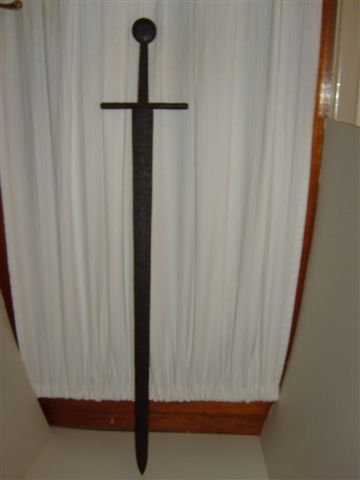
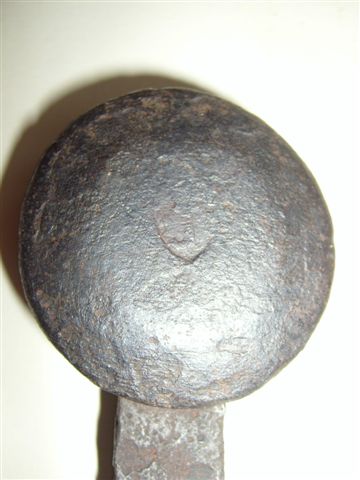
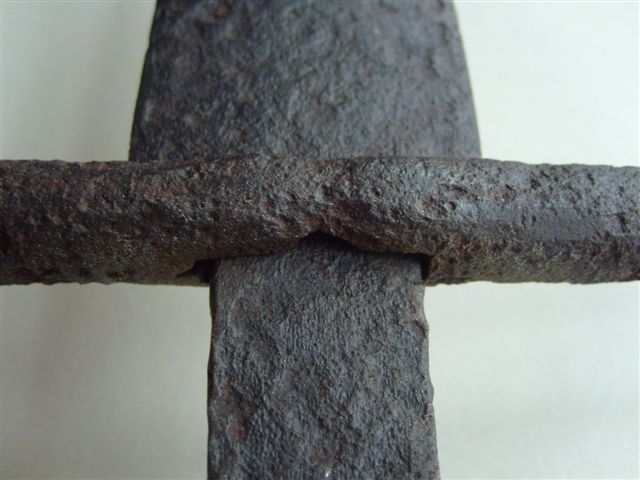
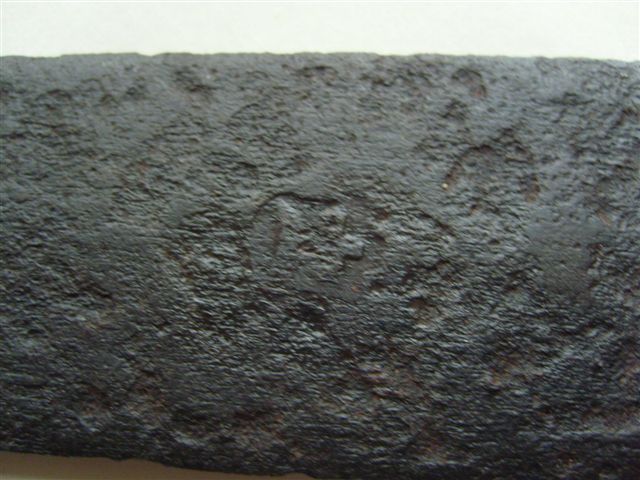
this can be a munition grade medieval sword, simple lenticular blade simple cross en pommel , but very good balance and capable of the job.


 Attachment: 18 KB
14th century sword 1.JPG


 Attachment: 30.31 KB
14th century sword 2.JPG


 Attachment: 46.08 KB
14TH C. SWORD Detail 2.JPG


 Attachment: 64.52 KB
14TH C SWORD Shield Mark.JPG

The problem with the historical record is that it has been triaged by time,we only see the survivors. I collect oriental stuff, some of it used as little as 70 years ago, oldest pieces 16th and 17th C in origin. A lot of reused blades, cut downs, reshaped and improvised stuff. However it is clear from surviving items and accounts that in the east you bought the best you could get, as your life depended on it. In North Africa the best was new (19C) soligen blades, and old good blades from european broadswords. The cheapest was and is local made iron ,might be steel, no fuller, fake soligen marked, lentoid section blades. Look up "takouba".
If in time of peril you absolutely must have a sword , better the cheap one you have , than the nice one you are still saving for.
Go to page Previous  1, 2

Page 2 of 2

Jump to:  
You cannot post new topics in this forum
You cannot reply to topics in this forum
You cannot edit your posts in this forum
You cannot delete your posts in this forum
You cannot vote in polls in this forum
You cannot attach files in this forum
You can download files in this forum


All contents © Copyright 2003-2006 myArmoury.com — All rights reserved
Discussion forums powered by phpBB © The phpBB Group
Switch to the Full-featured Version of the forum