Posts: 193
Sat 23 May, 2020 6:21 am
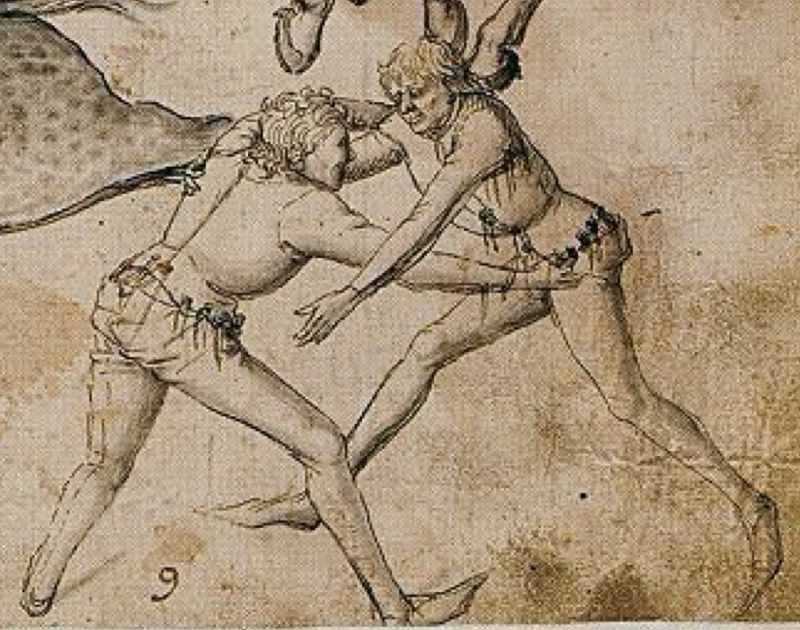
15th century arming doublets/hose and plumber's buttckack
Last edited by Kristjan Runarsson on Sat 23 May, 2020 9:32 am; edited 1 time in total
Posts: 159
Sat 23 May, 2020 7:34 am
The shirt is tucked into the pants on the back, and if it's long enough it won't wander out easily.
Simply put: you can't bend over if your Hosen are pointed to the back of your doublet, even sitting down is an issue if the attachment is relatively short. It has to be loose while standing to even allow you to sit down.
I've so far solved this conundrum by leaving some extra length on the rear points, so that it was taut when I bent over, and flopping around when standing. Leaving it open isn't too big an issue, either.
Plus, it may well be that these guys would normally have walked around with a robe or other outer garment that reaches down beyond the bum, but they've taken it off for some reason or other. (not getting it dirty, having full mobility, things like that)
A pair of joined Hosen may not even need to be tied up to the doublet to stay on, if you tie them together tightly in the front. Granted, if you're only wearing a short doublet, you may end up giving everyone a show, but with longer clothes like a robe or a cotehardie, it's not really an issue.
By the way, I'm extremely thankful for sharing that first image. I had never consciously seen Hosen not being laced up, but attached via belts. Seems way more convenient at a glance, I may have to try that myself.
Posts: 958 Location: Austria
Sun 24 May, 2020 2:54 am
| Kristjan Runarsson wrote: |
| Trouble is in N-Europe, because of the climate, hose and doublet were made out of thick and tightly woven wool that does not stretch all that much. |
Have you read The King's Servants and The Queen's Servants? They give a good summary of what fabrics were used for what garments (ie. doublets are rarely covered with any kind of worsted or woolen, and even more rarely with cloth) which works pretty well as a rule of thumb throughout the 14th, 15th, and 16th centuries.
You can generally assume that before 1850, the poorest people were dressed in fabrics you would consider terrifyingly expensive with mind-blowing properties.
This thread might also be helpful.
Posts: 958 Location: Austria
Tue 26 May, 2020 11:29 pm
| Kristjan Runarsson wrote: |
| My chief reference for the fabric types used in N-Europe are the Herjolfsnes finds. According to a book I read: Medieval Garments Reconstructed: Norse Clothing Patterns, they used pretty heavy and tightly woven fabric for their garments which did not give the impression of being especially elastic. |
Kristjan, the fabrics from Greenland are special: the Norse Greenlanders were peasants with very limited access to the market (and the local conditions only preserve wollens) so we are seeing one kind of textile used by people with limited resources. Back in Europe, the kind of people who wore armour wore all kinds of fabrics.
I doubt any of those farmers owned a doublet, and if they did the cotton, linen, and hemp rotted away.
Its not that the old fabrics were affordable- the English sumptuary laws allow ordinary working people to spend a third of their family's yearly income on the fabric in one outfit. But we live in a world of cheaply made fabrics adulterated with artificial fibres and designed to wear out after a few years, so there is 'sticker shock' when we see what it costs to make traditional fabrics which will last longer.
Posts: 271
Wed 27 May, 2020 9:09 am
I find this thread both timely and amusing. Not too long ago, I was tooling around Wiktenauer and looking at some of the links which stem from the I.33 page. This set of unglossed images is speculated to have been derived from the lost pages of I.33, though it's obviously much later than the speculative source document:
https://wiktenauer.com/wiki/Anonymous_sword_and_buckler_images
...Looking at the Erlangen Version images from 1500, I initially speculated that the illuminator was having a bit of fun by making the fencer's pants fall down, but that might have been, according to what I have been reading here, something that might have happened due to not tying the aft points and needing to move around with vigor!
...I am merely thankful that I do not wear tights!
You
cannot post new topics in this forum
You
cannot reply to topics in this forum
You
cannot edit your posts in this forum
You
cannot delete your posts in this forum
You
cannot vote in polls in this forum
You
cannot attach files in this forum
You
can download files in this forum
 Attachment: 70.3 KB