Posts: 782 Location: Upstate New York
Tue 06 Feb, 2007 2:28 pm
Visors...
Hello all!
Rodolfo,
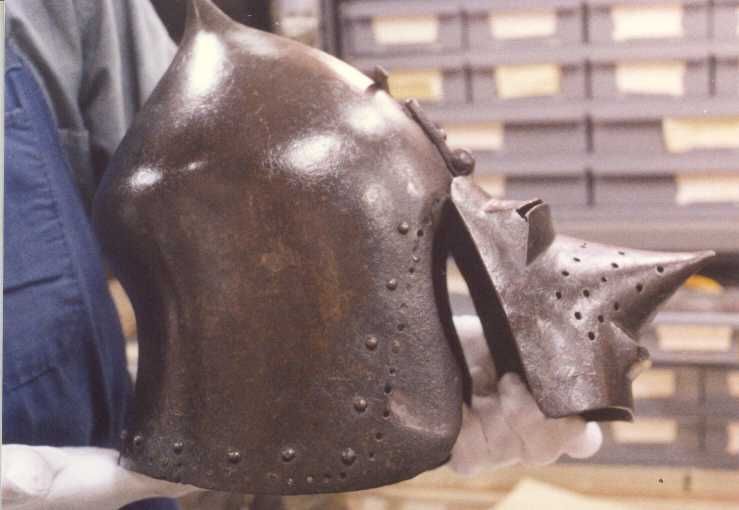
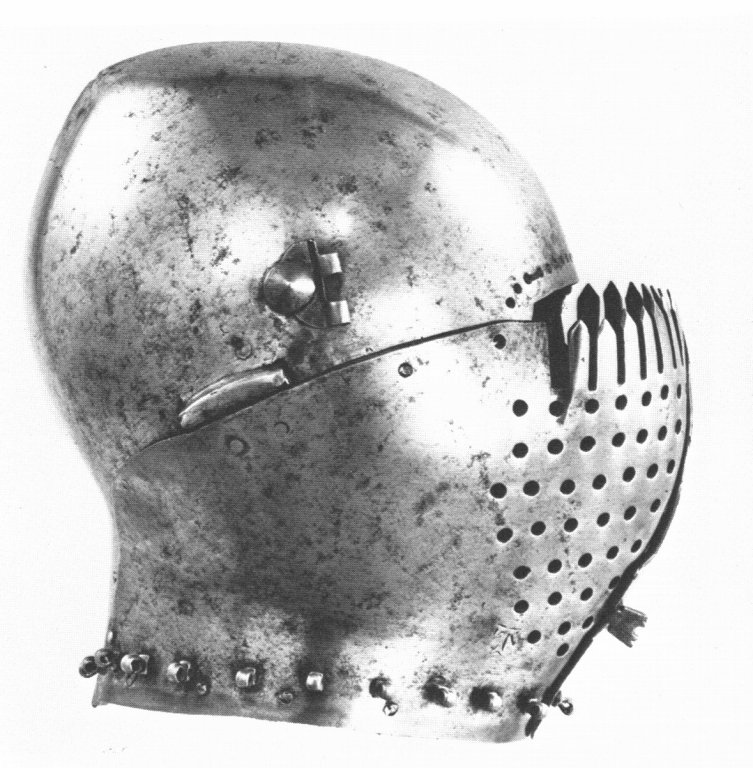
The term "pig-faced" is typically used to refer to the late fourteenth and early fifteenth century
bascinet visors that had an elongated "snout". Another term for these is
hounskull, a corruption of the German
Hundsgugel , hound's hood. These were usually called "visored bascinets", or the French equivalent, in Medieval England. These visors could be either side-hinged, or top-hinged, also known as
klappvisier. The conical snout of the hounskull or "pig-faced" visors became quite prominent by the late fourteenth century. (Again, check out the myArmoury article about the fouteenth century bascinet for some examples.)
There are actually several surviving examples of bascinets with "pig-faced" visors. There is an interesting one, made up of several pieces from the same period, of the late fourteenth century, in the Museo Civico L. Marzoli, in Brescia. There is a northern Italian once of circa 1380-1400 with aventail in the Churburg armoury. There is a second Milanese one from Churburg of circa 1390-1400 without an aventail, but with a slightly rounded snout. There is another bascinet of circa 1400, missing the aventail, in the Oldescalchi Collection. There is yet another of circa 1400-1410, this time with the central
klappvisier hinge, from Kunstsammlung der Veste, Coburg. And there is one of circa 1400 with a plate gorget, but still a pointed snout, in the Musee de L'Armee.
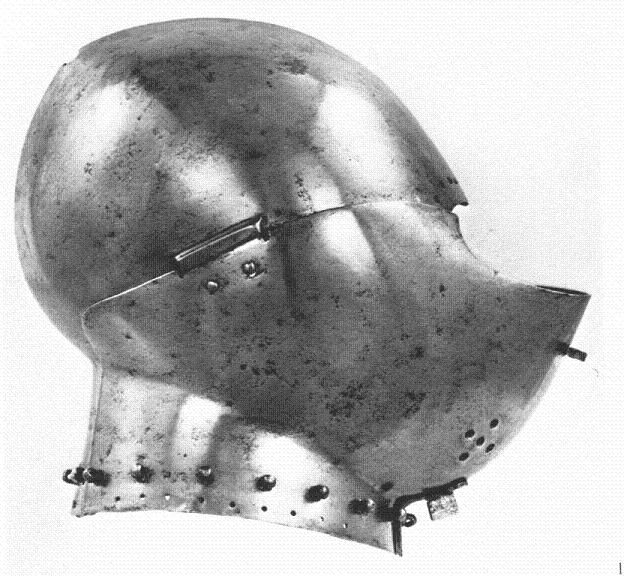
Sparrow's-beak visors are more typical of later helmets. The armet toward the middle of the fifteenth century developed into a shape called the "sparrow's beak" because of the blunt, sparrow's beak-like, point of the visor. This remained in use until the end of the century, and the visor was also adapted for use on the close-helmet.
I believe that the armet or close-helmet would have been popular for fully armoured warriors of the sixteenth century. Keep in mind, however, contemporary sources don't distinguish between the close-helmet and the armet. Both usually cover the whole head and face when the visor is lowered. Blair calls the close-helmet the most characteristic of the sixteenth century helmets.
I hope this helped!
 Attachment: 13.48 KB