Posts: 1,532 Location: Tennessee
Mon 15 Jan, 2007 9:51 pm
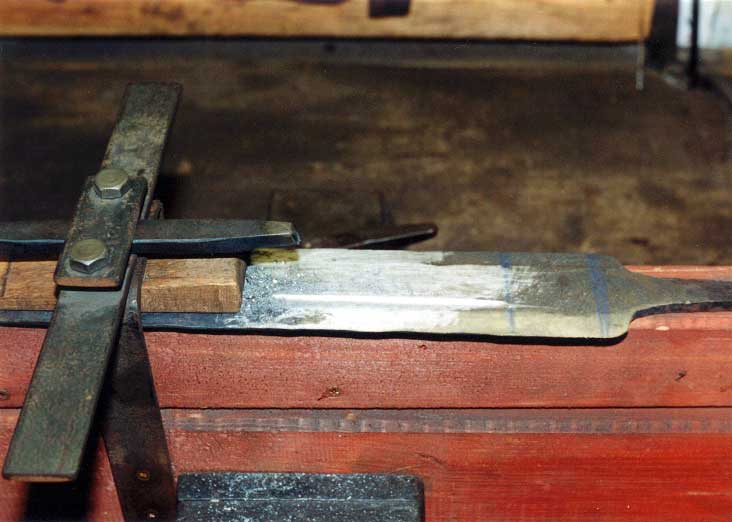
That is the only decent photo I have come across. A few other articles out there do mention a "grinding bench." Barta is credited with using traditional methods in the manufacture of his swords. The sword being produced here is a viking era replica. I suspect this is a "traditional" technique pre-modern to belt driven apparatus.
I believe a hardened metal blade (like a wood plane iron for cutting convex wood molding in principle) is used on the underside of Barta's sliding jig to cut the steel while it is in the softened annealed phase. This can work surpisingly fast if the cutting iron is well made and hardened high carbon and the sword blank is properly annealed (spherodized I think is the proper term if the material is actually a heat treatable spring grade of steel.)
Several pattern welders mention using this type of a jig today. The tang and tip may be clamped while working on most of the blade. Nails may also be used to trap the edge of the blank and keep it centered while working it. The beam the blade rests on is something like a simple 4"X4" timper that may be discarded afterwards (probably full of nail holes, rouge, and grit.)
My impressioin is that notches to represent depth of
distal taper are cut into the flat blank first. Much later, with a flat file, one can produce distal taper. A file can be worked on both sides until the notches disappear.
Fullers are the first to be filed or cut. These will later taper out automatically and disappear when grinding the distal taper and beveling the edges. I figured I would just buy a flat and half round mil file (several sizes which would cut an appropriate range fuller widths are available) and weld some threaded bolts to the back side of the files. Some rounded wet stones (sold for sharpening carving gouges) can also be bought to smooth the surface once it is close to final shape.
Polishing rouges are also utilized.
Some modern short cuts are to grind approximate edge bevels (not too deep) with an angle grinder.
The whole operation can be done with a simple saw horse, clamped on 4"X4" beam, simple home made jigs, and elbow grease + hours.
Alternatively you can; buy a CNC machine, move to a location near a river and build yourself a water propelled apparatus, spend years learning how to use one of those $600 (minimum) belt grinding machines without making a hollow ground edge..... etc.
I don't know how historical this actually is, but suspect it is very much traditional if Barta is using it.......
 Attachment: 38.09 KB