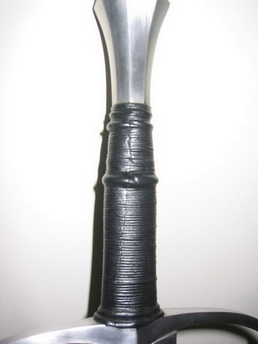
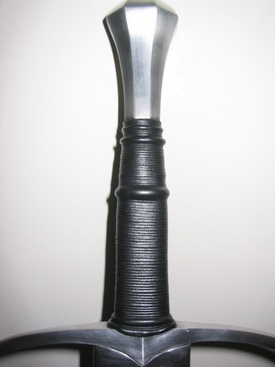
First I'll say a few words to introduce myself. My name is Julien, I'm a French born guy now living in London. It is my first post on myArmoury, but like many I have been crawling this forum daily for years now, trying to educate myself further in the matter of swords and learning about the treacherous subtleties of the modern replica market.
As far as I can remember, I have been interested in matters related to swords. I was (and still am) a Tolkien enthusiast, I studied history in university (even though I then spent most of my time then playing RPG at night at the time). My interest in swords became more specific when I became eager to find a "real sword" on the internet 5 years ago. The rest is easy to guess, since anyone who seriously asks himself that question should end up posting here after buying a handful of Ewart Oakeshott books and a few carbon steel blades.
My "collection" is very modest at present. My first sword was the well known Towton sword, shortly followed by a dynasty forge 1060 katana. I also own a genuine 1851 French Infantry short sword and a rather crude Guadeloupian machete (perfect for practicing polishing). I have been satisfied with those for a while now, but I’m afraid it won’t last since I’ve had my eyes on the Albion Crecy for too long now.
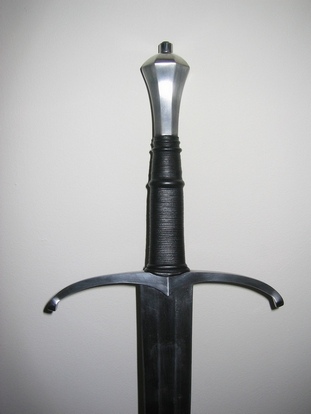
Now back to the topic of this post: making a new grip for the Towton. It is a well known fact that most windlass swords come with rather low quality grips. For all its improvements, the Towton was no exception. The grip is far too thick, made of poor quality leather, and worse, allowed no secure grip on the sword. The sword being rather slender and nicely proportioned, I had been keen on improving it the minute I took the sword out of the box. Though I’ve never seen nor touch an Albion sword yet (if someone is willing to show me one in London I’d be interested!), I found their grips to be very elegant and decided to try my luck at doing such an handle for my Towton. I’ve been reading thoroughly every post written on the subject of grip wrapping on myArmoury (especially Peter Johnson post) as well as Sean Flint customisation guides. All very precious advices that gave me a fairly good idea of the process.
But since it was my first try, two things really inspired me to start on the right foot: the short Albion video (how its made) were you can actually see how they wrap a sword (it’s brief, but I noticed that there was no cord underwrap, that the pattern were actually an imprint of the overwrap, I could have a better idea of the thickness of the leather used, how the raisers are placed and so on). The second is Greyson Brown’s wrapping of a maglite. Since I was sure to screw up the first attempt better make those mistakes on a worthless object than on the sword itself. So I did a quick and crude try on the first thing at hand, a large pen. I tried different combinations on it, with and without underwrap, different overwrap cord size, different raiser sizes etc and made all possible mistakes you can think of. From that I could decide that no underwrap would do best. My advice to all that want to attempt such an endeavour is not to skip this crucial trial step.
I won’t go into too many details, the process is well known here I’m sure. For materials I used cotton twine for the raisers, very thin lamb skin (a nightmare to find, prices on the net are off putting too…finely found plenty for 5 pounds a meter in a London flee market), nylon cord for the overwrap, and epoxy to bind it all. I did a lot of reshaping of the wooden grip before, using sandpaper and files.
Conclusion:
I am rather pleased with the results, but couldn't avoid a few mistakes. I did clamp the sword to allow better control during the overwrap but as a result I was hardly able to check the side facing the ground. Also I won’t try to pass over the raisers again when doing the overwrap, it leaves a mark and I wanted them well defined (next time I’ll cut the cord, attach a weight and will continue overwrapping using a new bit of cord on the other side of the raiser. Finally, I won’t use epoxy again for that kind of work, it is damn smelly when you’re working indoors, but it’s also too thick and increases the risks of getting bulges and other oddities. I’ll go for a lighter glue next time (any suggestions btw?). I’ll probably let this grip sit for a few month, take it off and do it all over again to get it better.
Pictures attached, looking forward to read your comments!
Cheers,
J.
 Attachment: 32.82 KB
 Attachment: 125.29 KB
[ Download ]
Attachment: 126.39 KB[ Download ]