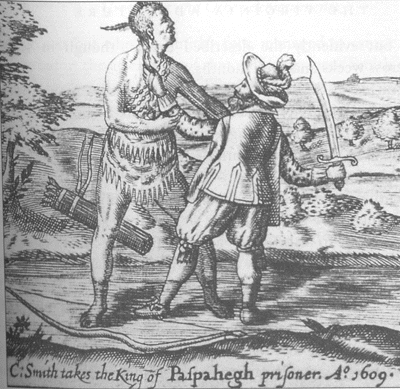
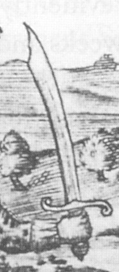
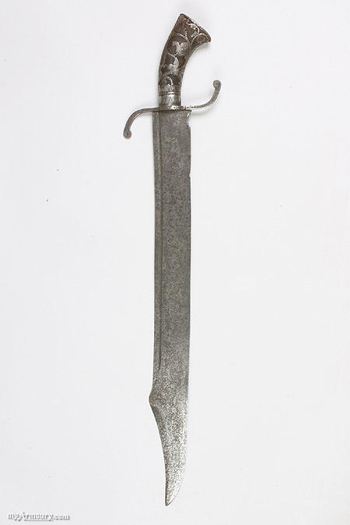
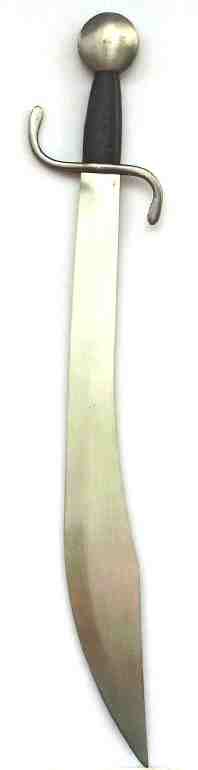
I'd love to see a flesh & blood example of this type. By the way, archaeologist Ivor Noel Hume has suggested that Smith might have supervised the illustrations for his writing. So, his weapon might be accurately rendered here.


| David R. Glier wrote: |
| Even *modern* militaries are begining to come around to the idea of well-made ancient weapons.
Rangers, as many of you have no doubt heard, have been recently issued tomahawks as part of their personal kits, after word of their extreme usefulness filtered back through the command chain. Army brass is still skeptical, but the troops are enthusiastic. Machetes have long been recognized as useful tools and weapons, but are often poorly balanced and have bad blade geometry -the soldiers just say they're hard to use. Yet, an entire Special Forces team ordered Cold Steel Kukris and sent back grateful reviews about their utility. Ditch the machete, design a falchion. I've used both, and I'll tell you which one is more useful in a heartbeat! Every solder or marine that I've convinced to try one agrees with me immediately. ;) |
| Sean Flynt wrote: |
| Has anybody seen this weapon?--clipped point, wide fuller, ball pommel, simple recurved quillons?
|

| E.B. Erickson wrote: |
| Ever since Sean posted it last week, the engraving of Smith's falchion has been ringing faint bells, and I think I remember where I saw something similar.
In the Wallace collection catalogs, they have a couple of Italian falchions/sabers from the early 1600s that are close to what is shown in the engraving. If I remember correctly, one has a rounded pommel with a spiral design and countercurved quillons, but I don't recall a clipped point to the blade. Anyone have a copy of the catalogs handy to check it out? --ElJay |